Do F1 Cars Have a Clutch? How the Paddles Start the Car
F1 cars use a real clutch, but the driver controls it with hand paddles on the steering wheel rather than a conventional floor pedal. Here is how the system works from the grid box to the first upshift.

Do F1 Cars Have a Clutch? Yes, but Not a Clutch Pedal
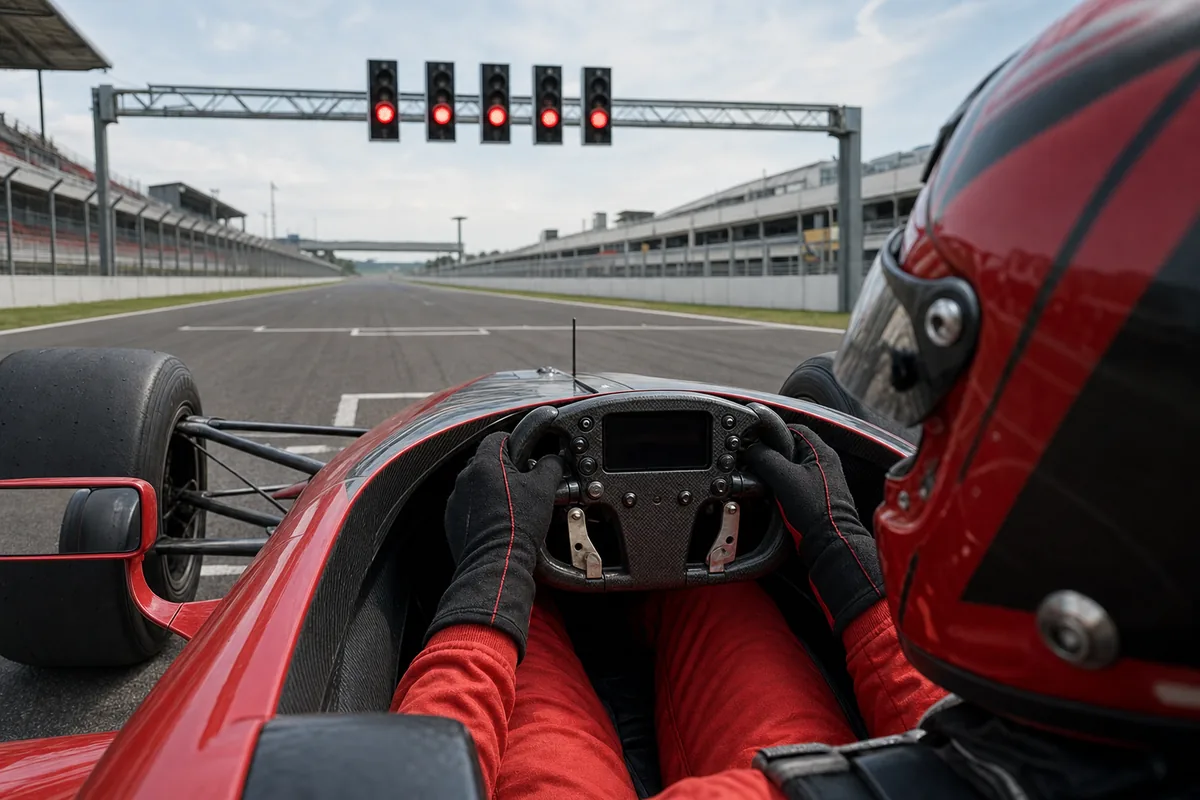
The direct answer is yes: F1 cars have a clutch. The confusing part is that the driver's feet do not operate it in the way a manual road car does. An F1 cockpit normally gives the driver accelerator and brake pedals, while clutch control sits behind the steering wheel as one or more hand-operated paddles.
The clutch still performs the familiar mechanical job of connecting and disconnecting engine torque from the gearbox. It lets the car pull away from rest without stalling and gives the driver controlled slip during a launch. Once the car is moving, the clutch is not manually pressed for every gear change; the electro-hydraulic semi-automatic system manages the shift when the driver pulls an upshift or downshift paddle.
That distinction matters when watching a start. Reaction to lights out is only the first part. A fast launch also depends on clutch preparation, bite-point control, throttle, grip, tyre temperature, and avoiding wheelspin.
| Control | Where it is | Main job |
|---|---|---|
| Clutch paddle | Behind the steering wheel | Engages the clutch for pull-away and race starts. |
| Gearshift paddle | Behind the steering wheel | Requests an upshift or downshift once the car is moving. |
| Accelerator | Right foot pedal | Controls requested engine torque. |
| Brake | Left foot pedal | Slows the car and works with brake-by-wire on the rear axle. |
Where Is the Clutch on an F1 Car?
The clutch itself is inside the transmission assembly between the engine and gearbox. The driver does not touch that hardware directly. Instead, the steering wheel sends a request through the car's control and hydraulic systems when a clutch paddle is moved.
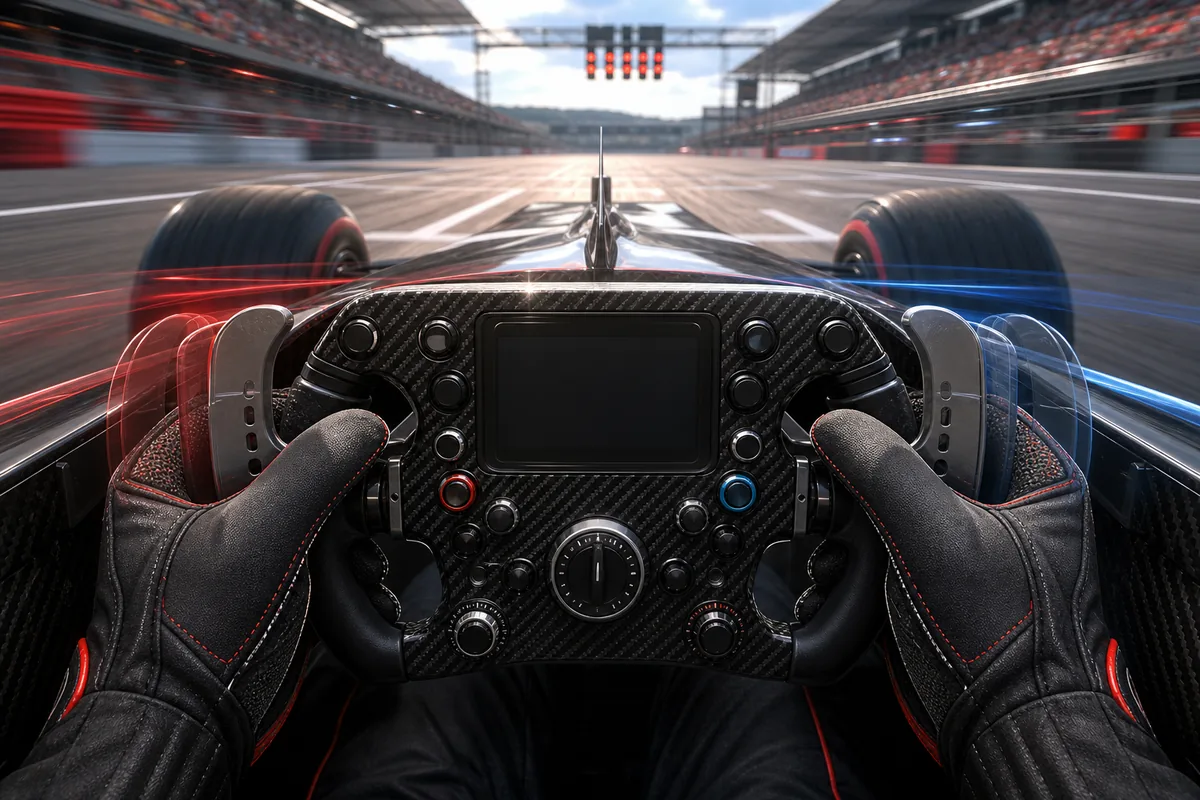
Modern steering wheels may use two clutch paddles so the driver can prepare a repeatable launch. The exact wheel layout and permitted control logic are tightly regulated, and teams develop their own hardware within those rules. To a viewer, the most useful point is simple: the lower rear paddles used during pull-away are different from the paddles used for normal gear changes.
The illustration below shows the general idea rather than a specific team's proprietary steering wheel. One paddle can be released to a prepared bite position while the second continues to hold the car's clutch command before the final release.
How F1 Clutch Paddles Work at the Race Start
A race start is not an automatic launch-control routine. The driver must prepare the clutch within the allowed settings, hold the car in position, watch the start signal, and release the paddles with the correct timing. The goal is to transmit as much usable torque as the rear tyres can accept without excessive wheelspin or a bogged-down engine.
Teams spend practice time finding a reliable bite-point window for the conditions. Grip changes with track temperature, rubber, tyres, fuel load, grid position, and even the painted surface beneath the rear wheels. The driver therefore follows a prepared procedure but still has to feel and correct the launch in real time.
The start can be understood as five linked actions. A mistake at any one of them can cost more places than a small difference in pure visual reaction time.
- 1. Prepare the bite point. The team and driver establish a legal clutch setting during reconnaissance and formation-lap procedures.
- 2. Hold the clutch. The driver stops in the grid box, selects first gear, and holds the clutch paddles while controlling the car.
- 3. React to lights out. When the red lights extinguish, the driver begins the launch without anticipating the signal.
- 4. Release to the bite point. The first movement rapidly reaches a prepared engagement point instead of dumping all torque instantly.
- 5. Complete the release. The remaining paddle travel is released as speed builds and traction stabilizes.
Clutch Paddles and Gearshift Paddles Are Not the Same
The back of an F1 steering wheel can look crowded, so it is easy to assume every paddle changes gear. In reality, the upper paddles commonly request shifts while lower or separate paddles control the clutch. Their functions, frequency of use, and timing are different.
During a normal racing lap, the driver may make dozens of gear changes without manually working the clutch paddles. The gearbox control system completes those shifts quickly after the driver requests them. Manual clutch input returns when the car must move from rest or when a driver needs to recover from a spin or near-stall situation.
| Situation | Clutch paddle | Shift paddle |
|---|---|---|
| Leaving the garage | Used to pull away smoothly | Used after the car is moving |
| Race start | Critical for launch and bite point | First upshift follows moments later |
| Normal lap | Usually not manually cycled every shift | Used repeatedly for upshifts and downshifts |
| Spin or stop | May help prevent a stall or pull away again | Selects the required gear |
Why Do F1 Cars Not Use a Normal Clutch Pedal?
Cockpit space is extremely limited, and drivers already use left-foot braking. Moving clutch control to the steering wheel keeps both feet dedicated to the accelerator and brake while placing launch controls within reach of the fingers. It also allows very precise, repeatable paddle travel in a compact package.
A hand clutch does not make the launch easy. The driver still has to combine paddle position with throttle, engine response, tyre grip, and the changing load on the rear axle. The mechanism is different from a road-car pedal, but the performance challenge remains mechanical and human rather than fully automatic.
F1 rules also restrict driver aids. The modern start is deliberately designed so the driver must execute the release rather than press a button that performs an ideal launch. That is why a driver can react well to the lights yet still lose positions through wheelspin or a poor bite-point release.
What Makes a Good F1 Launch So Difficult?
A strong launch has two separate time scales. First comes visual reaction: noticing that the lights are out and beginning the hand movement. Then comes traction management over the next seconds. Browser tools such as the F1 start timer can practice the first part, but they cannot reproduce clutch torque, tyre temperature, vibration, grid grip, or cars converging toward Turn 1.
The best reaction score is therefore not automatically the best race start. A driver who reacts a few hundredths later but hooks up the rear tyres cleanly may accelerate better than someone who reacts first and spins the tyres. Our reaction training guide focuses on clean, repeatable inputs rather than guessing the light.
Drivers must also avoid moving before the signal. Releasing the clutch too early can create a suspected jump start or trigger unwanted movement, which is why the start procedure combines patience with aggression. See the separate F1 jump-start rules guide for how early movement is judged.
The grid box itself can change the launch. Painted lines, rubber deposits, dust, and the exact position of the rear tyres may create different grip from one side of the car to the other. The driver therefore needs a quick reaction, but also enough sensitivity to correct the first metres without overreacting.
F1 Clutch vs a Manual Road-Car Clutch
Both systems interrupt and reconnect torque, but the driver's interface is very different. A manual road car expects the left foot to balance pedal travel and engine speed on most starts and shifts. An F1 driver operates a compact hand control mainly for pulling away, while rapid racing shifts are managed through the semi-automatic gearbox.
The comparison also explains why saying that an F1 car is simply an automatic is misleading. The driver requests every gear and performs the launch, but the transmission uses sophisticated hydraulic and electronic control to execute those commands at racing speed. It is better described as a highly regulated semi-automatic sequential system with a hand-operated clutch.
| Feature | F1 car | Manual road car |
|---|---|---|
| Driver clutch control | Steering-wheel paddle | Left-foot pedal |
| Use during each shift | Normally automated after paddle request | Usually pressed by the driver |
| Primary manual clutch use | Starts, pit exits, recovery | Starts and most gear changes |
| Launch objective | Maximum acceleration at available grip | Smooth, durable pull-away |
F1 Clutch FAQ
Official References
For the current regulatory framework, consult the FIA's Formula 1 regulations collection, including the current technical and sporting regulations governing transmission controls and race starts.
Formula 1's official steering-wheel control explainer provides additional context on the paddles and controls available to a driver. Team layouts vary, so the images on this page are editorial illustrations rather than a specific team's wheel.
Last updated: July 16, 2026