F1 Jump Start Rules: What Counts as a False Start?
A practical guide to early movement, lights-out timing, penalties, aborted starts, and how to practice F1 reaction timing without guessing.

What Counts as an F1 Jump Start?
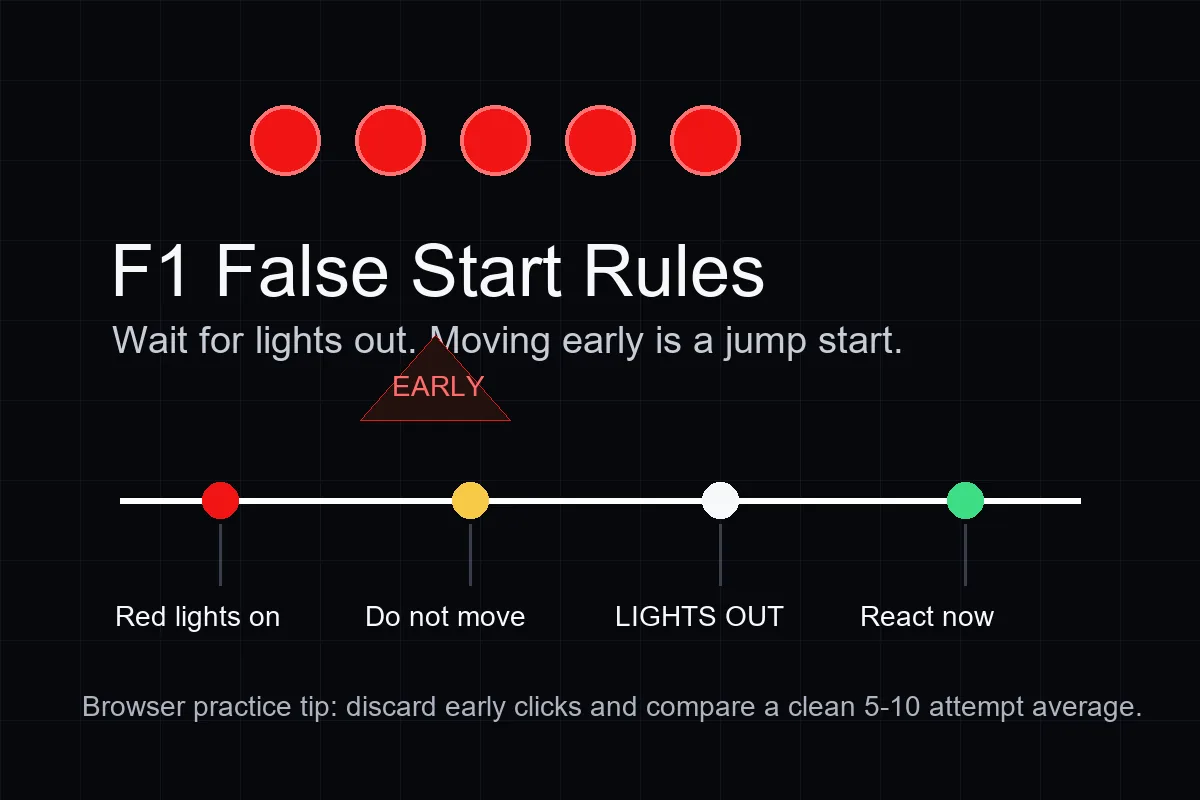
An F1 jump start is the common fan phrase for moving before the race is released. The official language usually focuses on false starts and start procedure, but the practical idea is the same: the car must stay stationary until the start signal is valid. In a normal lights-out start, that signal is the moment the red lights are extinguished.
The important detail is that drivers should not launch when the fifth red light appears. They must wait through the uncertain pause and react only when the lights go out. That is why the start is a reaction task rather than a fixed countdown.
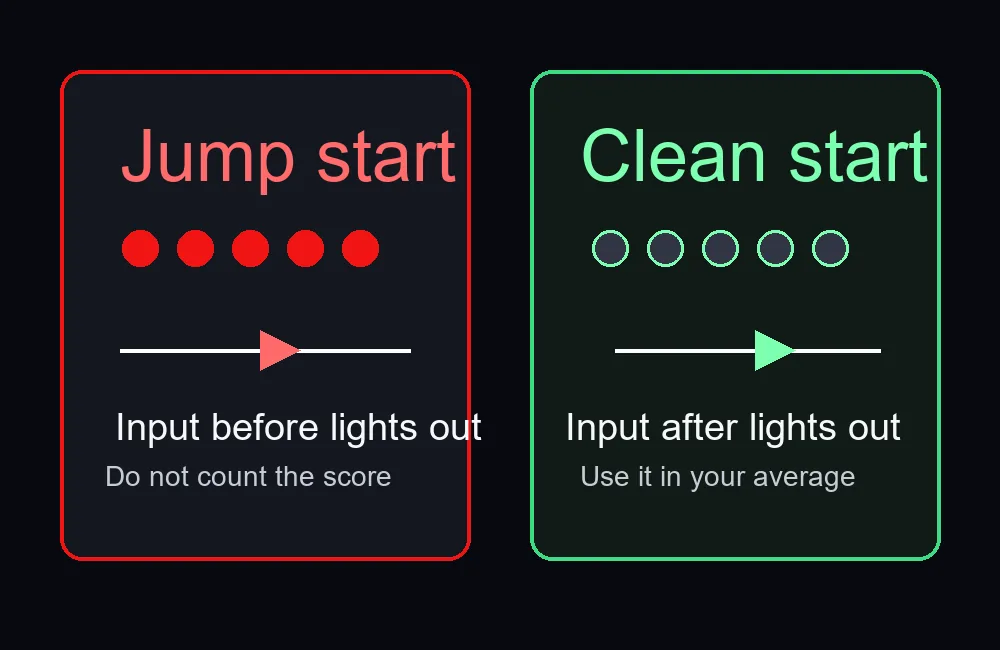
For online practice, use the same rule. If your hand moves before you clearly see lights out, the result may look fast, but it is not a clean reaction. Treat it like a jump start and remove it from your average.
| Moment | Valid reaction? | What it means |
|---|---|---|
| Before red lights go out | No | Early movement or an anticipated click. Do not count the result. |
| Exactly after lights out | Yes | This is the target moment for an F1-style reaction test. |
| Long after lights out | Yes, but slow | A valid response, useful for your average even if the score is not fast. |
How False Starts Are Detected in F1
Modern F1 starts are not judged only by what a viewer thinks they saw on television. Race control can use official timing, sensors, transponder information, video, and steward review to decide whether movement before the signal created a false start situation.
This matters because some visible motion may not automatically become a penalty. A car might rock slightly, settle, or appear to move in a way that does not match the official detection threshold. Fans often debate these moments because camera angles and broadcast replays can be misleading.
The safest explanation is to separate viewer language from official judgment. Fans say jump start when they see early movement. Officials decide penalties based on the current sporting regulations and the evidence available to race control.
- Viewer impression: what the broadcast angle appears to show.
- Official evidence: timing and detection data used by race control and stewards.
- Practical lesson: do not treat every tiny visual twitch as an automatic penalty.
What Penalty Can an F1 False Start Bring?
A false start can lead to a race-control investigation and a sporting penalty. The exact outcome depends on the regulations in force, the evidence, and whether the movement happened before the valid start signal. Penalties can include time penalties or other sanctions defined by the sporting rules.
For a fan guide, the exact penalty number is less important than the reason for the rule. A driver who moves early can gain a launch advantage or disrupt the start. The rule protects fairness and keeps every car waiting for the same lights-out signal.
In browser practice, there is no steward, so you need your own clean-start rule. If the attempt feels like a guess, mark it invalid. If your test shows an early-click warning, restart the run instead of saving the score.
| Situation | Real F1 consequence | Practice equivalent |
|---|---|---|
| Car moves before lights out | May be investigated and penalized | Discard the attempt |
| Driver reacts after lights out | Valid start if other rules are followed | Count the score |
| Start is stopped before release | Race control manages the procedure | Reset and wait for a new attempt |
False Start vs Aborted Start
A false start and an aborted start are related to the same high-pressure moment, but they are not the same thing. A false start is about a car moving before the valid signal. An aborted start means the start procedure is stopped or delayed before the race gets away.
An aborted start can happen for safety or procedure reasons, such as a car having a problem on the grid. In that case, the important instruction is to stop following the normal launch rhythm and wait for the next official signal.
This distinction helps when you read start-procedure news. Do not assume every delayed start is caused by a jump start, and do not assume every early movement creates an aborted start.
| Term | Core meaning | Fan takeaway |
|---|---|---|
| False start / jump start | Movement before the valid start signal | The driver may be investigated. |
| Aborted start | The start procedure is stopped before release | The field waits for reset instructions. |
| Clean start | Reaction after lights out | The launch is judged from the valid signal. |
How to Avoid Jump Starts in an F1 Reaction Test
The best way to practice is to make early clicks boring and invalid. Do not reward yourself for a suspiciously fast number. A useful F1 reaction session should include clean attempts, repeated under the same setup, with the average judged more seriously than the personal best.
Start with the F1 Start Timer, run five to ten attempts, and record the clean average. If you want more background on the light sequence, read the F1 starting lights guide. If you are comparing your score to driver-style benchmarks, use the F1 driver reaction time in ms guide.
- Watch the whole cluster: react to the lights going out, not the rhythm of the lights turning on.
- Discard early movement: if you guessed, do not count the score.
- Use a clean average: five to ten valid attempts are more useful than one extreme number.
- Keep one device setup: mouse, keyboard, touch input, screen refresh rate, and browser load can all change results.
F1 Jump Start FAQ
Sources and Scope
This guide is an independent fan explanation of start timing and reaction practice. For official wording, steward authority, and current penalties, consult the latest FIA Formula 1 regulations.
F1 Start Timer is not affiliated with Formula 1, FIA, or any racing team. Browser reaction scores are approximate and should be compared only under similar device conditions.
Last updated: June 2, 2026