Average F1 Pit Stop Time: What Counts as Fast?
A practical guide to two-second tyre changes, full pit-lane time loss, fastest-stop records, and the strategy mistakes that make a stop look slower than it really is.

Average F1 Pit Stop Time: The Useful Answer
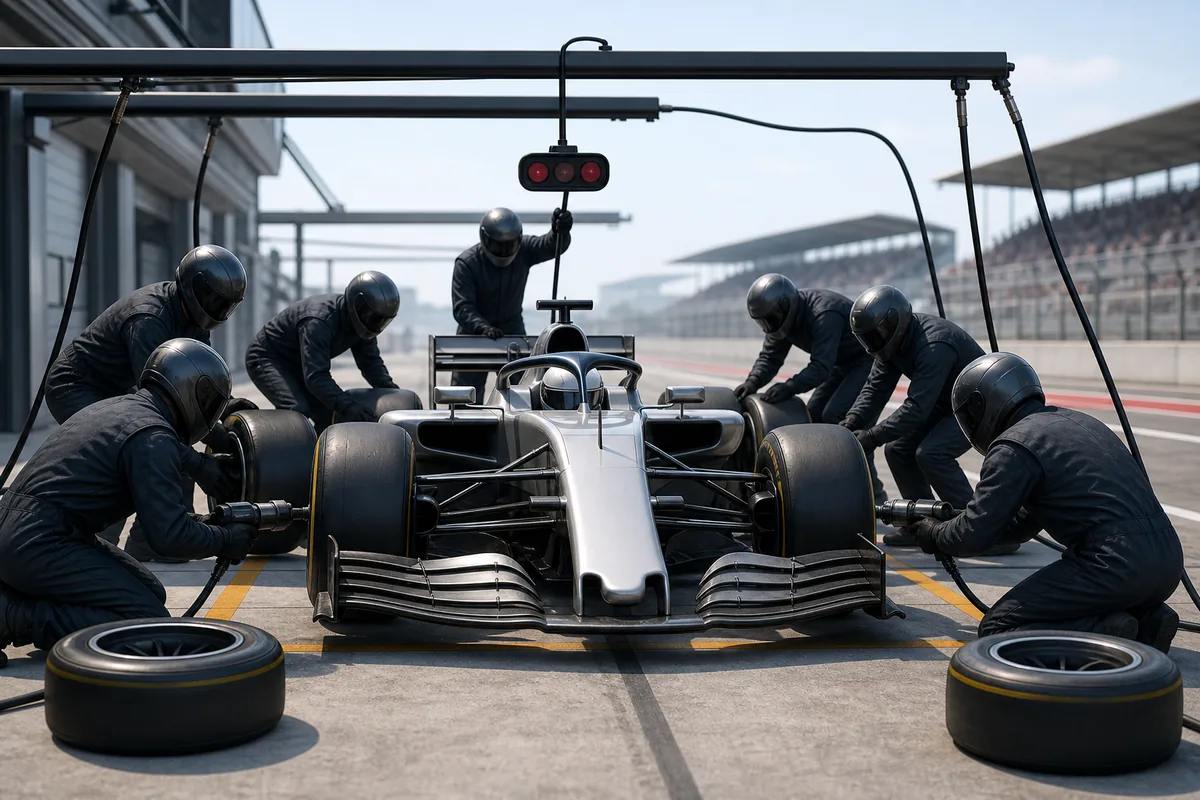
When fans ask for the average F1 pit stop time, they are usually asking about the stationary tyre change: the moment the car stops in the box until it is released. For competitive modern Formula 1 teams, a good stop is commonly discussed in the low two-second range. Anything around two to three seconds is broadly normal for a clean tyre-only stop, while elite stops can fall below two seconds.
The number on broadcast graphics can be confusing because it is not the same as the total race-time cost. A 2.3-second tyre stop does not mean the driver only lost 2.3 seconds to the cars that stayed out. The full loss also includes slowing into the pit lane, driving at the pit-lane speed limit, positioning the car, and rejoining the track.
Use this guide as a practical reader: tyre-change time tells you how well the crew executed the stop; pit-lane loss tells you how expensive the strategy was in the race.
| Number you hear | What it usually means | How to read it |
|---|---|---|
| 1.8-2.0 seconds | Exceptional stationary tyre stop. | Record-level or near-record execution, if the release is safe. |
| 2.1-2.5 seconds | Very strong modern F1 stop. | Usually a clean stop that helps strategy. |
| 2.6-3.5 seconds | Still usable, but not elite. | May be fine unless rivals are much faster. |
| 4+ seconds | Problem or delay likely. | Watch for a wheel-nut issue, traffic, slow release, or car positioning problem. |
| 20+ seconds race loss | Full pit-lane cost, not just tyre change. | Depends on circuit layout, safety car status, and pit-lane speed limit. |
What Is the Average F1 Pit Stop Time?
There is no single official public average that applies to every race, team, and season. The practical benchmark is easier: fast race teams aim for a repeatable tyre stop in roughly the two-second window, and anything under 2.5 seconds is normally a strong stop by modern standards.
That does not mean every real stop will land there. Wet-weather tyre changes, double-stack stops, traffic in the fast lane, damaged parts, wheel-gun trouble, or a driver missing the marks can all add time. A team may also choose a slightly safer release over a risky fraction of a second.
For search intent, the best answer is therefore a range, not one magic number: a clean F1 tyre stop is commonly around two to three seconds, the best stops can be under two seconds, and the total time lost to the race is much higher than the stationary stop.
| Pit stop result | Crew execution | Race meaning |
|---|---|---|
| Under 2.0s | Rare, record-level coordination. | Tiny stationary loss, but still only one part of strategy. |
| 2.0-2.5s | Excellent stop. | Strong enough to support an undercut or defend track position. |
| 2.5-3.0s | Normal to good. | Usually acceptable unless the rival stop was much faster. |
| 3.0-4.0s | Slight delay. | Can cost a position when margins are tight. |
| Over 4.0s | Likely issue. | Often visible as a wheel, jack, release, or traffic problem. |
Pit Stop Time vs Pit-Lane Time Loss
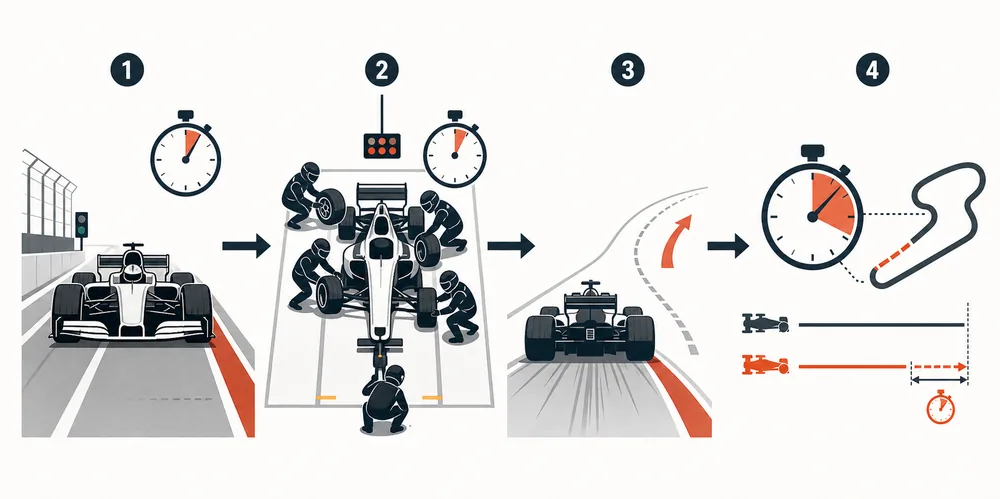
The biggest pit stop misunderstanding is mixing up stationary time with total time loss. Stationary time is the stopwatch on the crew. Pit-lane time loss is the cost of the whole detour from racing speed, through the pit lane, and back to racing speed.
This is why a race strategist may say a stop costs far more than the two-second tyre change. The driver gives up speed before entering the pit lane, travels under the pit-lane speed limit, stops for service, then accelerates back onto the circuit. Circuit layout changes this number dramatically.
Safety cars and virtual safety cars change the equation again. If the field is already moving slowly, the relative cost of pitting can be lower. That is why a correctly timed pit stop can gain track position even when the stationary stop itself is not a record.
| Stage | Stationary time? | Race-time loss? |
|---|---|---|
| Pit entry braking | No | Yes |
| Pit-lane speed limit | No | Yes |
| Car stopped in the box | Yes | Yes |
| Tyre change and release | Yes | Yes |
| Pit exit and acceleration | No | Yes |
Why Are F1 Pit Stops So Fast?
Modern F1 stops are fast because every person has one narrow job. The crew does not improvise around the car; it performs a rehearsed sequence where wheel-gun operators, tyre carriers, jack operators, stabilizers, and release checks all happen in a fixed rhythm.
The driver matters too. The car must arrive straight, stop exactly on the marks, stay stable while raised, and leave only when released. A tiny positioning error can make a mechanic reach, reset, or delay a wheel change.
This is the pit-lane equivalent of a lights-out reaction test: the headline number is small, but the repeatable skill is built from timing, preparation, and avoiding false moves. On this site, the F1 reaction time guide explains the driver-side timing mindset; pit stops show the same precision at team scale.
- Specialized roles: each mechanic handles a narrow action, reducing hesitation.
- Thousands of rehearsals: teams practice normal stops, awkward tyre changes, and emergency scenarios.
- Precise car positioning: the driver must stop on the marks so tools and tyres meet the car cleanly.
- Safe release discipline: a fraction saved is worthless if it creates an unsafe release or loose wheel risk.
Fastest F1 Pit Stop Records
Fastest-stop records are usually measured as stationary tyre-change time. Formula 1 reported McLaren and Lando Norris completing a 1.80-second tyre change at the 2023 Qatar Grand Prix, a headline world-record benchmark for modern pit stops.
Record lists are useful, but they can mislead casual fans if they are treated as the normal expectation. A team can win the race strategy with a 2.3-second stop if the timing is right, while a 1.9-second stop can still lose value if the driver rejoins in traffic or the strategy window was wrong.
The better comparison is repeatability. A single record shows the ceiling; a season of clean two-second-range stops shows operational strength. That is similar to browser reaction practice: one perfect click is less useful than a repeatable average.
| Benchmark | Meaning | Caution |
|---|---|---|
| 1.80s McLaren stop in Qatar 2023 | Widely cited modern world-record tyre change. | Record pace is not the same as every-race average. |
| Low two-second stops | Elite operational target. | Still depends on safe release and driver positioning. |
| Fastest-stop award tables | Good for comparing crews by event. | They measure stop execution, not the whole race strategy. |
Why Pit Stop Timing Matters More Than the Stopwatch Alone
A pit stop is a strategy tool, not just a mechanic-speed contest. Teams choose when to stop based on tyre wear, traffic, track position, safety car probability, weather, and the gap to rivals. A fast stop helps, but the timing of the stop can be even more important.
The classic examples are the undercut and overcut. In an undercut, a driver pits earlier, uses fresh tyres, and tries to jump a rival before that rival stops. In an overcut, a driver stays out longer and tries to gain from clear air, tyre life, or a later race event. Both strategies still need a clean stop, but neither is explained by stationary time alone.
For viewers, the key is to watch the gap before the stop, the stationary time, and where the driver rejoins. Those three pieces explain the race impact better than the pit stop number by itself.
| Strategy term | Simple meaning | What pit stop time changes |
|---|---|---|
| Undercut | Pit earlier and use fresh tyres to gain time. | A slow stop can ruin the attempt. |
| Overcut | Stay out longer and use pace or clear air. | A clean later stop protects the gain. |
| Double stack | Two team cars stop on the same lap. | The second car may wait if spacing is tight. |
| Safety car stop | Pit while the field is slowed. | Total time loss can be lower than under green flag. |
How to Read Pit Stop Graphics During a Race
Broadcast graphics often show the stationary stop first because it is easy to understand. If the number is green, purple, or labeled fastest, the crew probably executed well. If it jumps above four seconds, look for a delayed wheel, jack issue, slow release, or traffic in the fast lane.
Then check the live timing gap. A driver can have a great stationary stop and still lose a place if the pit window was too tight. A driver can also have a merely average stop and gain a position if the strategy forced a rival into traffic.
If you enjoy timing details, use the same mindset as the F1 stopwatch guide: define which clock you are reading before judging the number. Pit box time, pit-lane delta, lap time, and race gap are related, but they answer different questions.
- Stationary stop: how long the car was stopped while the crew changed tyres.
- Pit-lane delta: how much time the pit lane route costs compared with staying on track.
- Rejoin position: the real proof of whether the stop and strategy worked.
- Traffic after release: a fast stop can still be neutralized if the driver rejoins behind slower cars.
F1 Pit Stop Time FAQ
Sources and Scope
This guide explains viewer-facing pit stop timing and strategy. Formula 1’s official pit stop explainer describes modern good stops in the low two-second range and notes McLaren’s 1.80-second world-record benchmark. Mercedes-AMG Petronas also explains why many modern stops happen in 2.5 seconds or less. Formula1.com pit stop explainer Mercedes-AMG F1 pit stop explainer
For official race procedure, tyre-use obligations, pit-lane rules, and penalties, consult the current FIA Formula 1 regulations. This site is an independent fan resource and is not affiliated with Formula 1, FIA, DHL, McLaren, Mercedes, or any racing team. FIA Formula 1 regulations Formula 1 DHL Fastest Pit Stop results
Last updated: July 5, 2026