How F1 Qualifying Works: Q1, Q2, Q3 and Timing
A beginner-friendly guide to Q1, Q2 and Q3, qualifying time, eliminations, pole position, and the route from a timed result to the race grid.

What Is F1 Qualifying?
F1 qualifying is the session that decides the base order for the race start. Drivers are not racing wheel-to-wheel for position during qualifying. Instead, each driver tries to set the fastest possible lap time while managing traffic, tire temperature, fuel load, and track limits.
The important idea is simple: faster lap times usually earn better starting positions. The fastest driver in the final part of qualifying normally takes pole position, which means starting from the front of the F1 starting grid unless later penalties change the official grid.
Qualifying matters because track position matters. A driver who starts near the front has cleaner air and less traffic into the first corner. A driver who qualifies badly may still have race pace, but must pass more cars and accept more first-lap risk after the lights out signal.
If you are asking how long F1 qualifying lasts, separate the official session clock from the time you spend watching. The timed segments total 46 minutes in this format: 18 minutes for Q1, 15 for Q2, and 13 for Q3. Red flags, announcements, broadcast transitions, and delays can make the complete programme longer than the sum of those clocks.
| Term | Simple meaning | Why it matters |
|---|---|---|
| Qualifying | Timed laps that decide the base race-start order. | It is the main path to pole and front-row track position. |
| Q1 | The first knockout segment. | The slowest cars are eliminated before Q2. |
| Q2 | The second knockout segment. | It decides who reaches the top-10 shootout. |
| Q3 | The final shootout for the fastest remaining cars. | It decides pole and the front grid slots. |
How Q1, Q2, and Q3 Work
Modern F1 qualifying is a knockout format. Everyone starts with a chance in Q1. The slower group is removed, the remaining cars reset for Q2, and the fastest survivors reach Q3. This structure keeps pressure high because a driver can be eliminated by one traffic mistake, one track-limits deletion, or one badly timed run.
For 2026, Formula 1 has a 22-car grid. Formula 1's official beginner guide describes qualifying as three stages: Q1 lasts 18 minutes, Q2 lasts 15 minutes, and Q3 lasts 13 minutes. With 22 cars, six are eliminated after Q1 and six more after Q2, leaving 10 cars for Q3.
The official format is easy to remember if you separate survival from pole. Q1 and Q2 are about avoiding elimination. Q3 is about attacking the front of the grid.
Q2 in F1 is the middle elimination session. The drivers who advance from Q1 get another fresh chance to set a time, while the slowest group at the end of Q2 is eliminated and fills the next block of grid positions. Times from Q1 do not carry over, so a driver must produce a competitive lap again in Q2.
| Segment | Length | Who advances | What it decides |
|---|---|---|---|
| Q1 | 18 minutes | Fastest 16 cars advance | The slowest six are placed toward the back of the grid. |
| Q2 | 15 minutes | Fastest 10 cars advance | Positions just outside the top 10 are set before penalties. |
| Q3 | 13 minutes | No advance; this is the shootout | The top 10 order, including pole position, is decided. |
- A lap must be valid: Track-limit violations can delete a time and push a driver into danger.
- Timing matters: A late red flag, yellow flag, or traffic queue can ruin a final attempt.
- Tires matter: Soft tires are usually the qualifying tire, but preparation laps and temperature can decide whether the final lap works.
Why Qualifying Lap Times Change So Much
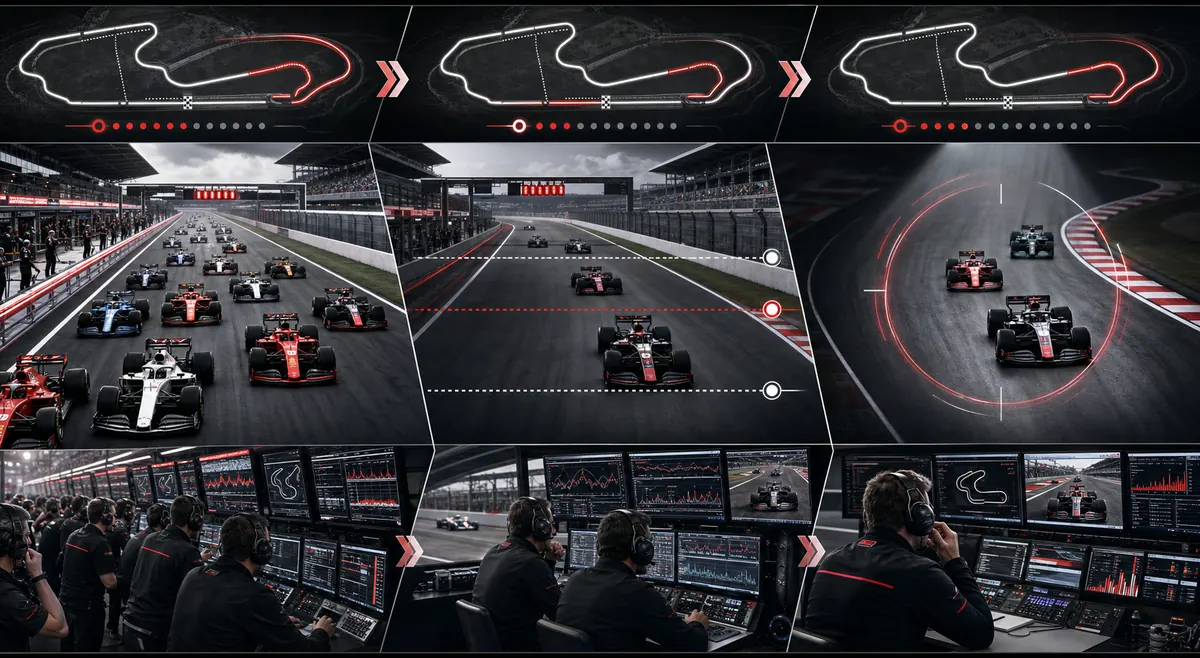
A qualifying result is not only about who has the fastest car on paper. Track grip usually improves during the session as rubber goes down. That means a lap set late in a segment can be much faster than a lap set early, even if the driver did not suddenly find a huge improvement.
Traffic is another major factor. Drivers need space before a push lap, but a short circuit can become crowded when everyone wants the same final minute. A driver can lose time by catching another car, meeting a slow car on a preparation lap, or being forced to start the lap with cold tires.
Teams also plan fuel and tire use carefully. A car with less fuel is quicker, but the driver may need enough energy and tire temperature for one or two push laps. This is why a driver might leave the garage early for a banker lap, then return later for one final attack.
This is why a qualifying session can feel as if it accelerates near the end. The track may be faster, the tyres may finally be in their working window, and every driver is trying to use the same final minutes. A lap that looks safe early can become vulnerable once the whole field completes a later run.
| Factor | Effect on lap time | What viewers should watch |
|---|---|---|
| Track evolution | Later laps can be faster as grip improves. | Expect quick times near the end of each segment. |
| Traffic | A clean lap can be blocked by slower cars. | Watch onboard gaps and radio complaints. |
| Tire preparation | Too cold or overheated tires reduce grip. | Listen for warm-up lap and out-lap references. |
| Flags | Yellow or red flags can force drivers to abort. | A late flag can trap a fast car in the danger zone. |
How Qualifying Becomes the Starting Grid
Qualifying creates the first version of the grid, but it is not always the final version. After qualifying, grid penalties, pit-lane starts, parc ferme changes, power-unit component penalties, and steward decisions can move cars before the race starts.
That is the boundary between this guide and our starting grid guide. Qualifying explains how the timed order is created. The starting grid explains how that order is converted into final grid boxes for the formation lap and lights-out start.
For most casual viewing, the practical rule is: use qualifying to understand performance, then use the final grid to understand who starts where. A driver can be fastest on Saturday and still start lower if a confirmed penalty applies.
After the chequered flag, the classification is checked against lap deletions, penalties, and official documents. The qualifying order is therefore the starting point for the grid, not a promise that every car will occupy the same position at lights out. Checking the final grid is the safest way to connect Saturday qualifying with Sunday’s start.
| Layer | What it tells you | Can it change? |
|---|---|---|
| Qualifying classification | Who set the fastest valid lap in each segment. | Yes, if laps are deleted or penalties are later applied. |
| Provisional grid | Expected start order after early penalty application. | Yes, until official documents settle it. |
| Final starting grid | Where cars actually line up before the formation lap. | This is the order to use before lights out. |
F1 Qualifying vs Sprint Qualifying
A sprint weekend can include Sprint Qualifying as well as Grand Prix Qualifying. The names are similar, but the output is different. Sprint Qualifying sets the grid for the Sprint, while Grand Prix Qualifying sets the grid for Sunday's race.
Formula 1's official sprint guide describes Sprint Qualifying as SQ1, SQ2, and SQ3, with shorter segment lengths than normal qualifying. That is why a schedule may show two qualifying-style sessions in one weekend.
If you are new to F1, first ask which event the session is setting up. If the session is called Sprint Qualifying, it is about the Sprint grid. If it is standard Qualifying, it is about the Grand Prix grid.
For the separate Sprint format, see our F1 Sprint race guide; this article keeps its main focus on Grand Prix qualifying.
| Session | Segments | Main purpose |
|---|---|---|
| Grand Prix Qualifying | Q1, Q2, Q3 | Sets the race grid, before penalties. |
| Sprint Qualifying | SQ1, SQ2, SQ3 | Sets the Sprint grid on sprint weekends. |
| Race start | Formation lap and lights out | Uses the final grid, not just raw lap-time order. |
How to Watch F1 Qualifying as a New Fan
The easiest way to follow qualifying is to watch the elimination line. In Q1 and Q2, the driver in the last safe position is the reference point. Everyone below that line is at risk, and every late improvement can push someone else into the drop zone.
Do not focus only on P1 in the first two segments. The fastest driver is interesting, but the real drama often sits around P16 in Q1 and P10 in Q2. In Q3, the focus shifts to pole because all remaining cars are safe and the top grid slots are the prize.
After qualifying ends, check the final grid before the race. That one extra step prevents confusion when a penalty moves a car, when a car starts from the pit lane, or when a broadcast graphic differs from the raw qualifying classification. To understand the timing gap behind a lap, read our F1 delta time guide.
| If you see this | What it means | Best reaction |
|---|---|---|
| Driver is below the cut line | They are currently eliminated. | Watch whether they have time for one more lap. |
| Driver sets a banker lap | They have a safe early time, not necessarily their best. | Expect a later push if they have tire life. |
| Track limits deleted | A lap time was removed. | Check whether the driver falls into danger. |
| Penalty announced after qualifying | The grid may change. | Use the final starting grid before judging the race start. |
- For practice on this site: qualifying decides where cars start, while the F1 Start Timer helps you practice the separate lights-out reaction moment.
- For race previews: combine qualifying pace, final grid position, tire strategy, and first-corner layout.
F1 Qualifying FAQ
Sources and scope
This guide is a fan-facing explanation of F1 qualifying, with the current 22-car Q1, Q2, and Q3 timing used as the practical example. Session formats can change, so the latest event documents should take priority.
For official penalties, deleted laps, and final grids, use the current FIA Formula 1 regulations, race documents, and the official Formula 1 weekend guide.
This site is an independent fan-made practice resource and is not affiliated with Formula 1, FIA, or any racing team.
Last updated: August 12, 2026