F1 Starting Lights Explained: What Happens Before Lights Out?
A clear guide to the five red lights, the variable wait, false-start risk, and why an F1 start signal feels harder than a normal countdown.

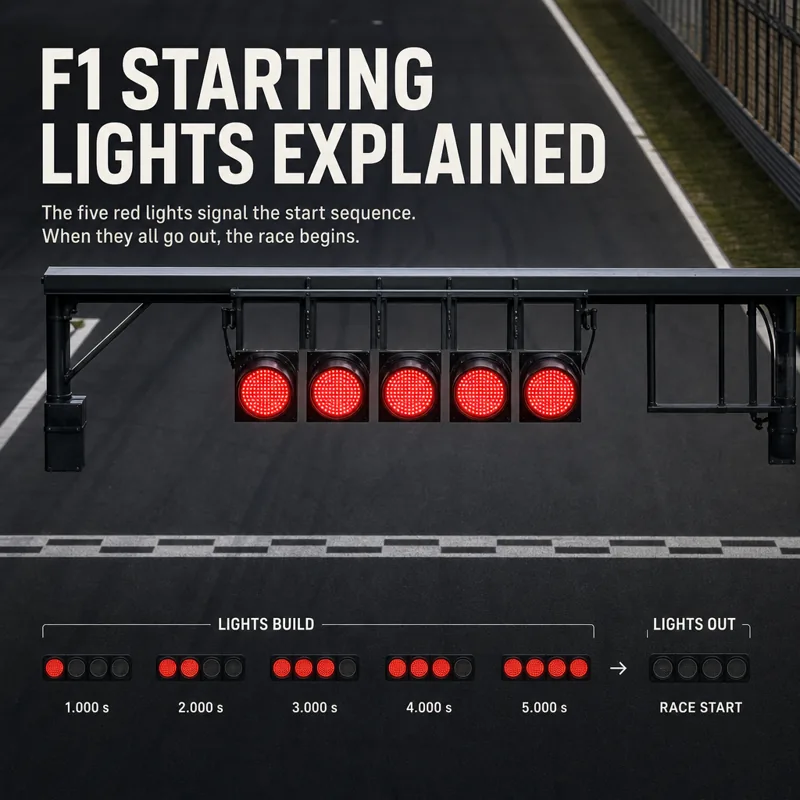
How the F1 Starting Lights Sequence Works
The F1 start signal is built around a row of five red lights. Before the race begins, the red lights come on and drivers hold their cars ready on the grid. The actual start is not the moment the lights appear. It is the moment those lights are extinguished.
That is why fans often hear the phrase lights out. It means the red lights have gone off and the race is live. For a driver, the job is to wait through the build-up without moving early, then react instantly when the visual signal disappears.
The sequence matters because it creates uncertainty. If the delay were always identical, drivers could simply memorize the rhythm. A variable lights-out delay forces them to respond to the signal rather than the count.
The core rule
Do not react to the fifth red light appearing. React to the red lights going out.
F1 Starting Lights: Step-by-Step Meaning
For viewers, the start looks like a short light show. For drivers, every phase has a different job: prepare the launch, hold position, avoid creeping, and respond only after the lights out signal.
This table separates what you see from what the driver is trying to control.
| Stage | Driver focus | Viewer meaning |
|---|---|---|
| Cars line up | Hold the car in the grid box and prepare clutch, throttle, and launch settings. | The field is ready, but the race has not started. |
| Red lights illuminate | Stay still, manage tension, and watch the whole light cluster. | The start sequence is active. |
| Variable wait | Avoid predicting the exact moment and keep the car stationary. | The next change can happen at any instant. |
| Lights out | React to the extinguished lights and execute the launch. | The race has begun. |
Is an F1 Start a Countdown or a Random Lights-Out Signal?
Many searches for F1 starting lights come from people expecting a normal countdown. The visible build-up feels like a countdown, but the useful reaction cue is still the lights going out after a variable pause.
This distinction matters for practice. If you count the rhythm, you are training anticipation. If you wait for the extinguished lights, you are training the same visual patience that the start signal demands.
| Search intent | Correct answer | Practice tip |
|---|---|---|
| F1 countdown lights | The red lights build in sequence, but the final release is not a fixed count. | Use the sequence to get ready, not to predict the start. |
| F1 lights out meaning | Lights out means the red lights have extinguished and the race is live. | React to the disappearance of the lights. |
| F1 start signal site | An online timer can mimic the visual cue, not the full car launch. | Compare clean averages and discard guessed starts. |
Why F1 Lights Out Tests Reaction Time
An F1 start is not a simple reflex game, but the first movement still depends on reaction timing. The driver must recognize the lights-out cue, release the launch sequence, and avoid doing it too soon.
This is also why an online F1 Start Timer can be useful practice. It does not simulate clutch bite, tire grip, or a full race launch, but it does train the one part fans can easily practice in a browser: waiting for the visual signal and reacting without anticipation.
- The cue is visual: drivers and users respond to the disappearance of red lights, not a sound or fixed number.
- The delay is uncertain: a variable wait makes guessing less reliable than focus.
- Consistency matters: a clean 5-10 attempt average says more than one lucky fast reaction.
- Device timing matters online: monitor refresh rate, input method, and browser workload can shift a browser score.
False Starts, Jump Starts, and the Start Signal
A false start or jump start happens when a car moves before the valid start signal. In real racing, that can lead to penalties because the driver gained or attempted to gain an advantage before the race was released.
In browser practice, the equivalent is clicking before you truly see lights out. It may create an impressive number, but it does not show a real reaction to the start signal.
| Situation | Meaning | Practice tip |
|---|---|---|
| You click before lights out | That is anticipation, not a valid reaction. | Discard the attempt and restart. |
| One result is far faster than the rest | It may be a guess or a timing glitch. | Compare your average instead of your best. |
| Your results slow after many attempts | Focus and hand position may be fading. | Take a short break and run fewer attempts. |
How to Practice the F1 Start Signal Without Guessing
The best practice method is boring but useful: repeat the same conditions, react only after lights out, and compare averages. That pattern teaches patience as much as speed.
Use the homepage timer when you want a quick F1 start signal drill, then return to this guide when you need to explain what each part of the sequence means.
- Watch the whole light cluster. Do not stare at one red light or count a fixed rhythm.
- React only when the lights disappear. The valid cue is lights out, not the final red light turning on.
- Run 5 to 10 attempts. A short average is more reliable than one personal best.
- Keep the same setup. Mouse, keyboard, touch input, display, and browser can all change the score.
F1 Starting Lights FAQ
Sources and Scope
This guide explains the public, viewer-facing meaning of the F1 start signal and how to practice the visual reaction pattern online. For official race procedures, always refer to the current FIA Formula 1 regulations.
For browser timing limits, MDN's performance.now() reference explains high-resolution timing, while device latency and display refresh still affect what users experience.
This site is an independent fan-made practice resource and is not affiliated with Formula 1, FIA, or any racing team.
Last updated: June 17, 2026