F1 Starting Grid Explained: Pole Position, Grid Slots, and Lights Out
A practical guide for newer fans: how qualifying creates the starting order, why penalties can change it, what pole position really means, and how the grid turns into the lights-out start.

What Is the F1 Starting Grid?
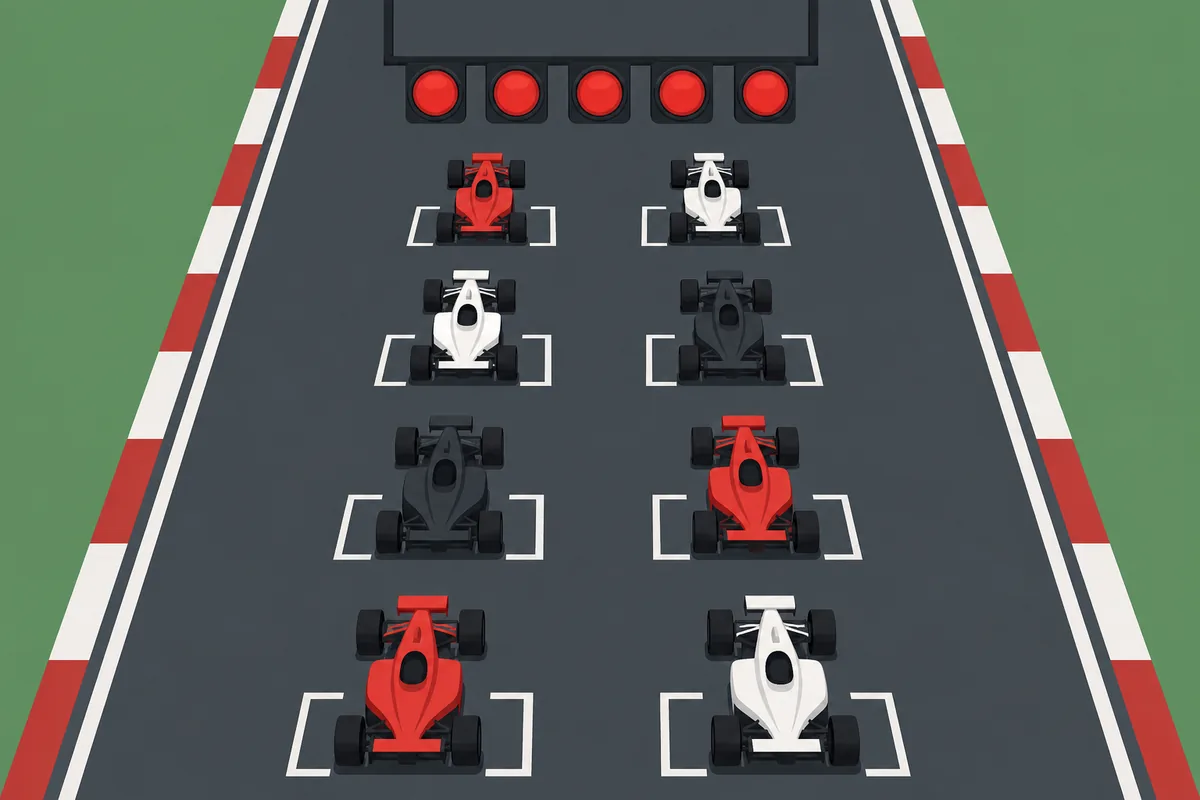
The F1 starting grid is the ordered set of positions where the cars line up before a Grand Prix or sprint starts. Each car stops in a marked grid box, usually arranged in a staggered pattern across the track. The car listed first starts from the front row, and the rest of the field lines up behind in the official order.
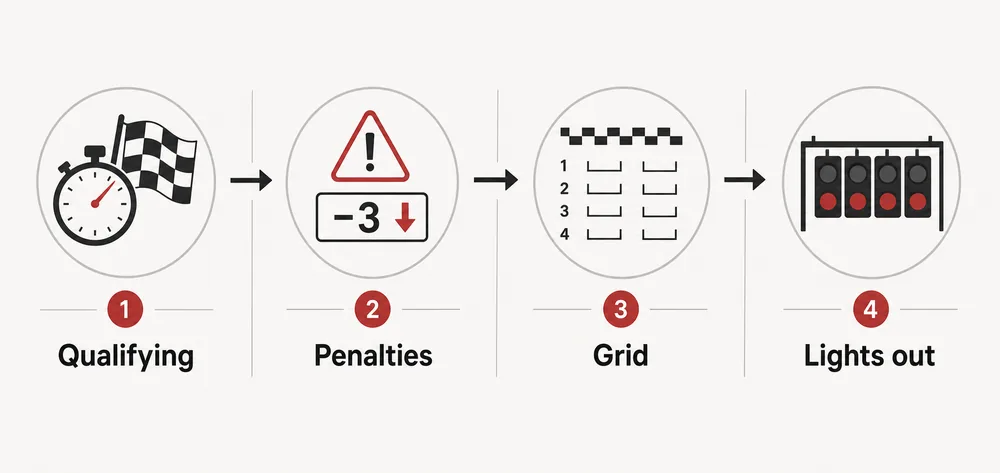
For viewers, the grid is the bridge between qualifying and the race. Qualifying tells you who was fastest over one lap, but the final grid tells you who is actually allowed to start from each slot after penalties and procedural decisions are applied. That is why broadcast graphics sometimes show a different order from the raw qualifying result.
The grid also shapes the first corner. A driver near the front has cleaner air and less traffic, while a driver near the back must pass more cars and manage more risk. On tracks where overtaking is hard, grid position can be almost as important as race pace.
| Term | Simple meaning | Why fans should care |
|---|---|---|
| Starting grid | The final order and exact boxes where cars start. | It tells you who launches from each position when the lights go out. |
| Grid slot | One marked box on the start-finish straight. | Drivers must stop accurately before the start signal. |
| Front row | The first two starting positions. | These cars often have the best chance to control turn one. |
| Back of the grid | The last race-start positions. | Usually caused by slow qualifying, penalties, or permission to start after missing a session. |
How Is the F1 Starting Grid Decided?
In a standard Grand Prix weekend, qualifying creates the base order for the race. Drivers try to set the fastest lap time, and the quickest drivers earn the better starting positions. The exact session format can vary by season and sprint weekend rules, but the basic idea is simple: faster qualifying performance usually means a better place on the grid.
The final grid is published after the sport applies any penalties or special start conditions. A driver might qualify high but drop places because of a power unit change, gearbox-related issue, impeding penalty, parc ferme breach, or other steward decision. Another driver may be required to start from the pit lane if the team changes the car outside allowed conditions.
This is why serious fans separate three layers: qualifying classification, provisional grid, and final starting grid. The final grid is the one that matters for the launch and for interpreting pole, turn-one risk, and strategy.
| Layer | What it shows | Can it change? |
|---|---|---|
| Qualifying result | Lap-time order from the qualifying session. | Yes, if laps are deleted or penalties apply. |
| Provisional grid | Expected starting order before every decision is final. | Yes, because penalties or pit-lane starts may still be confirmed. |
| Final grid | Official race-start order and grid boxes. | This is the key order for the formation lap and start. |
| Actual launch | What happens after lights out. | The start can still be aborted, delayed, or affected by stalls. |
Pole Position vs Starting P1: Why It Can Be Confusing
Most casual fans say pole position means the driver who starts first. In normal weekends that is usually true, because the fastest qualifier often starts from P1. The confusing part is what happens when penalties change the official grid. Depending on the current regulation wording and official classification, the driver credited with pole may be tied to the final grid order rather than the raw fastest qualifying lap.
For a beginner guide, the safest phrasing is: pole is the first position on the official starting grid. If the fastest driver is moved back by a confirmed grid penalty, the broadcast may discuss both the fastest qualifying lap and who actually lines up first. Read the final grid graphic before assuming those are the same person.
This distinction matters for records, fantasy games, betting-style discussions, and race previews. A driver who was fastest in qualifying but starts lower still has pace, but the driver in P1 has the immediate track-position advantage when the red lights go out.
| Question | Practical answer | What to check |
|---|---|---|
| Who was fastest in qualifying? | The driver with the quickest valid qualifying lap. | Qualifying classification. |
| Who starts first? | The driver listed first on the final grid. | Final starting grid document or broadcast graphic. |
| Who has the turn-one advantage? | Usually the car starting P1, but track layout and grip side matter. | Grid side, run to turn one, and start performance. |
| Can pole change after penalties? | The official answer depends on the final grid and current rules. | Use official FIA/F1 race documents for that event. |
Grid Penalties, Back-of-Grid Starts, and Pit-Lane Starts
Grid penalties are one of the main reasons the starting grid differs from the qualifying order. A driver can drop a specific number of positions, be moved behind other classified drivers, or start from the pit lane depending on the offence or technical change. Power unit component changes are a common reason fans hear about grid drops during a weekend.
Penalties are applied in a defined order, which is why grid graphics can look complicated when several drivers have penalties at once. A five-place penalty does not always mean a driver simply moves from fifth to tenth if other penalties and unclassified drivers are also involved. The final grid resolves those interactions.
Pit-lane starts are a separate practical case. If a car starts from the pit lane, it does not occupy its original grid box at lights out. That can affect the visual grid, the formation lap, and how many cars are actually waiting on the start-finish straight.
| Situation | Common effect | How to read it |
|---|---|---|
| Five-place or 10-place grid drop | The driver starts lower than the qualifying result. | Look for penalty notes beside the driver name. |
| Multiple component penalties | The driver may be sent toward the back. | Do not calculate by mental math only; use the final grid. |
| Parc ferme or setup changes | The driver may start from pit lane. | The car will not launch from its original grid slot. |
| Stewards allow a driver to start after issues | The driver may be placed behind classified cars. | Check official race notes for permission and position. |
- Use the final grid, not only qualifying: the final grid is the version that accounts for penalties and start conditions.
- Expect strategy changes: a penalized quick car may choose a different tire or overtaking plan.
- Watch the empty boxes: pit-lane starts or non-starters can make the visible grid differ from the published order.
From Starting Grid to Formation Lap to Lights Out
Once the final grid is set, the race still has a procedure before the start. Cars first take the formation lap, return to their grid boxes, and wait for the start lights. The key reaction moment is not when drivers arrive at the grid; it is when the red lights are extinguished.
The starting grid and the F1 starting lights work together. The grid decides where each car begins. The lights decide when those cars may move. If a driver moves too early, the start can become a jump start or false-start issue.
For fans using this site, the same split helps with practice. The grid is about position and preparation; a lights-out reaction test is about waiting for the valid cue. Use the F1 Start Timer when you want to train that visual reaction separately from the full race procedure.
- Grid: sets the starting boxes and track-position advantage.
- Formation lap: lets drivers warm tires, brakes, systems, and focus before returning to the grid.
- Red lights: create the final waiting phase before the race begins.
- Lights out: releases the race and tests reaction without moving early.
How to Read an F1 Starting Grid Graphic
Before the race, broadcasters and official timing pages usually show the grid from front to back. Read it as a race-start map, not just a list of qualifying results. The first row shows the immediate fight for turn one, while the rows behind show who must attack, defend, or survive traffic.
Look for three clues: penalty markers, pit-lane-start notes, and tire or strategy context. A fast driver starting tenth after a penalty may be more important to the race story than a slower car starting fifth. Likewise, a front-row car on the dirty side of the track may have a harder launch than the grid number suggests.
If you are practicing reaction time, use the grid graphic as a reminder that starts are not only reflexes. Position, grip side, clutch control, visibility, and the lights-out cue all combine. A browser test isolates the reaction part so you can practice it cleanly.
| What you see | What it might mean | Best follow-up |
|---|---|---|
| Driver starts lower than qualifying | Grid penalty or setup-related start change. | Check penalty notes before judging pace. |
| Empty grid slot | Pit-lane start, non-starter, or procedural change. | Listen for race control and team radio context. |
| Fast car out of position | Potential early overtaking story. | Watch the first stint and tire choice. |
| Front row split by track side | Grip and racing line can matter. | Watch launch quality, not just grid number. |
F1 Starting Grid FAQ
Sources and Scope
This guide is a fan-facing explanation of grid terminology and race-start context. For official wording and event-specific decisions, use the current FIA Formula 1 regulations and race documents.
For broader race-weekend context, Formula 1's official beginner guides explain qualifying, race formats, and penalties. This site is an independent practice resource and is not affiliated with Formula 1, FIA, or any racing team.
Last updated: June 27, 2026