F1 Reaction Test World Record: What Counts as a Real Start?
A practical guide to record claims, impossible scores, clean averages, and how to judge your best lights-out reaction time without confusing a lucky guess for a real start.

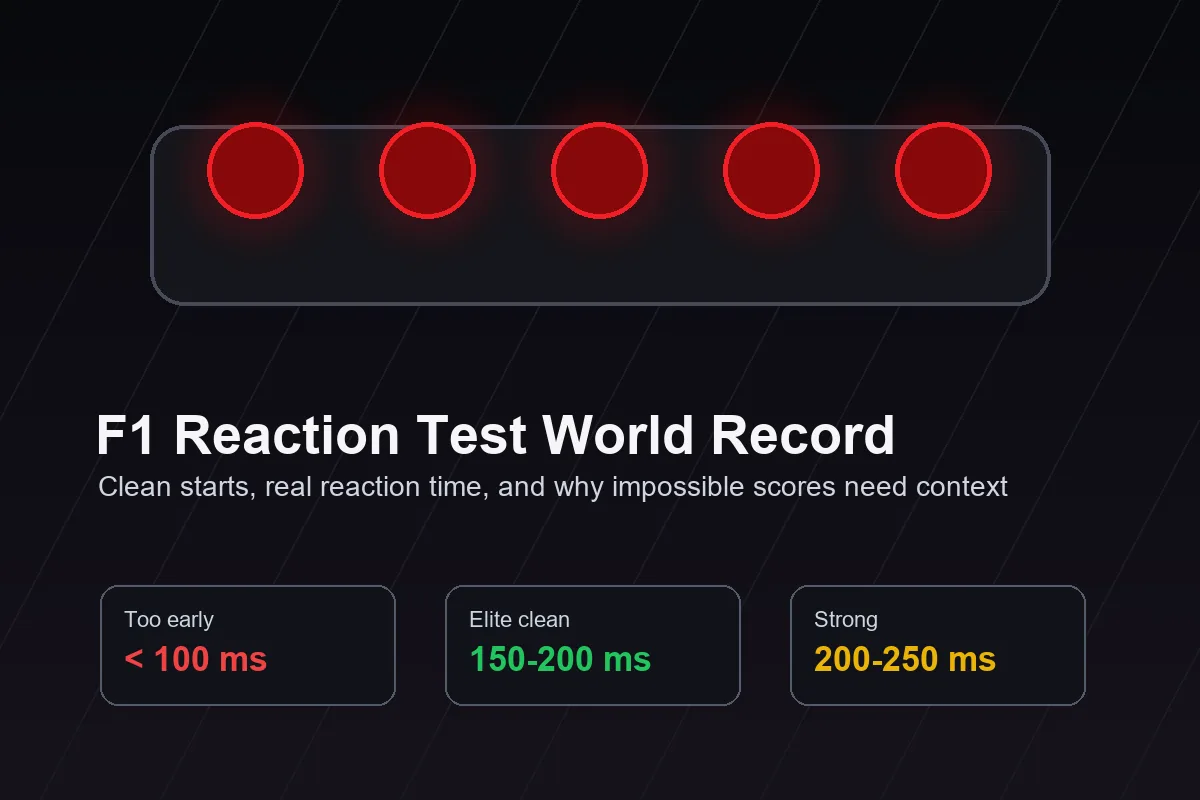
Is There an Official F1 Reaction Test World Record?
For online start-light games, the honest answer is no: there is not one universal, official F1 reaction test world record that all sites use. Each timer, app, or leaderboard measures a slightly different thing. Some start on a mouse click, some use touch input, some penalize early clicks, and some depend heavily on browser timing and display refresh rate.
That does not make record attempts pointless. It means the record has to be defined clearly. A useful claim should say which timer was used, whether false starts were rejected, how many attempts were recorded, what input device was used, and whether there is video evidence. Without that context, a single best number is more entertainment than a reliable benchmark.
This is why your best score on an F1 Start Timer should be read together with your average. A clean 5-10 attempt average says more about reaction control than one unusually fast result surrounded by early clicks.
A record claim also needs to separate reaction from prediction. If the input begins before the visual cue is processed, the number may describe anticipation rather than visual reaction. That is why a repeatable clean average and a full recording are stronger evidence than one leaderboard screenshot.
What F1 Reaction Test Score Is Realistic?
A realistic browser score depends on the screen, input device, browser workload, and whether the test uses a variable lights-out delay. Still, broad ranges are useful. They help you tell the difference between a strong clean reaction and a number that probably came from guessing.
Use this table as a practical filter, not as an official ranking. The same person can score differently on a gaming mouse, laptop trackpad, phone screen, or busy browser tab.
For keyword searches such as fastest F1 reaction time, the important distinction is record entertainment versus repeatable measurement. A fast personal best is useful only when the surrounding attempts prove you were reacting to the visual cue rather than predicting it.
| Score range | How to read it | Record-quality check |
|---|---|---|
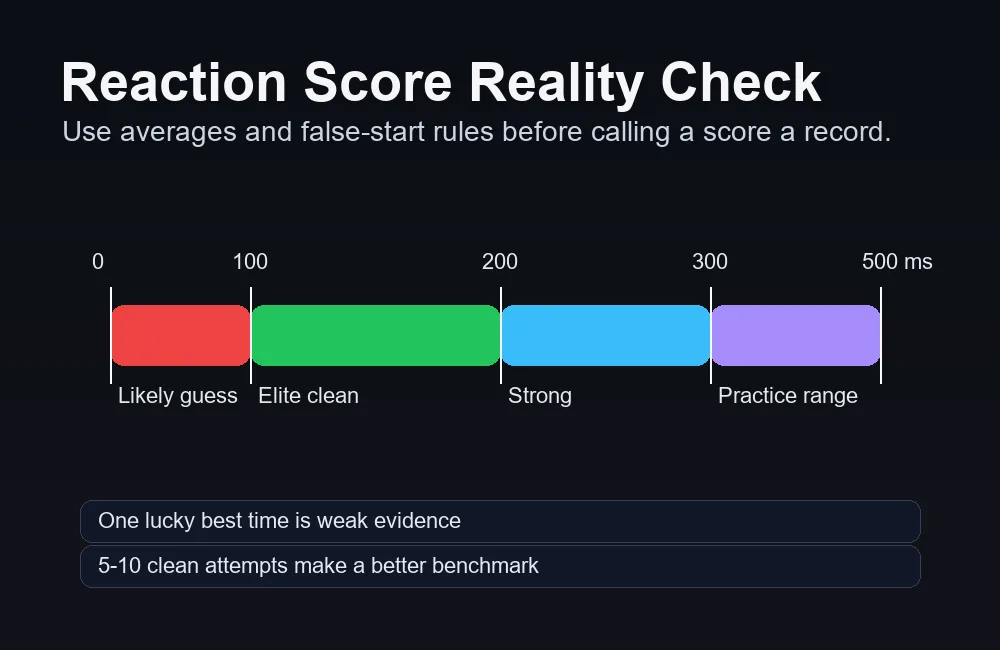
| Under 100 ms | Usually too fast for a clean visual reaction in a browser test. | Needs video proof and strict false-start review. |
| 100-150 ms | Possible as an exceptional score, but anticipation is a serious risk. | Repeat the test and compare the next several attempts. |
| 150-200 ms | Excellent lights-out reaction territory for many browser tests. | More credible if several clean attempts cluster nearby. |
| 200-250 ms | Strong and realistic for focused F1 start practice. | A good target range for consistent training. |
| 250-300+ ms | Common casual range, especially on touch screens or slower devices. | Improve setup consistency before judging progress. |
Why Impossible F1 Start Timer Records Happen
Most suspicious record claims are not cheating in a dramatic sense. They come from timing edge cases, anticipation, or a misunderstanding of what the test measures. In an F1-style start, the valid cue is lights out, not the rhythm before it.
The faster a score looks, the more carefully it should be checked. A 90 ms result may look impressive on a screenshot, but if the user clicked because they predicted the lights rather than saw them go out, it is not a clean reaction.
- Anticipation: clicking before the brain has actually processed lights out can create an unrealistically fast number.
- Device variance: display refresh rate, input polling, touch delay, Bluetooth latency, and browser scheduling all affect the final score.
- One-off luck: a single extreme result is weaker evidence than a stable group of clean attempts.
- Timer differences: different sites may start, stop, round, or reject attempts in different ways.
How to Verify Your Best F1 Reaction Test Time
If you want to treat a best time as a personal record, use a simple verification routine. It does not need to be complicated; it just needs to remove the most common sources of false confidence.
The key is to document the setup and prove that the result came after the lights went out. For public claims, a screen recording with visible input timing is much stronger than a cropped screenshot.
If you share a record claim, include the timer used, input method, device type, browser, whether audio was enabled, and the 5-10 attempt average. Those details make the score comparable without changing the page into a leaderboard.
| Check | Why it matters | Practical rule |
|---|---|---|
| False-start rule | Pre-clicks make a score invalid. | Discard any attempt where you moved before lights out. |
| Repeat attempts | Records should not depend on one lucky guess. | Run 5-10 clean attempts and save the average. |
| Same device | Hardware and browser timing change scores. | Compare records only on the same screen and input method. |
| Video evidence | Screenshots cannot prove when you clicked. | Record the full start sequence for serious claims. |
Credible personal record checklist
- The attempt starts only after the red lights are fully out.
- The same device, browser, screen, and input method are used for the comparison.
- The claimed best is shown next to a 5-10 attempt average, not alone.
- Any public claim has full-sequence video rather than only a cropped result screenshot.
How to Practice for a Clean Personal Record
The best way to improve is not to chase the lowest possible number on every attempt. That encourages guessing. Instead, practice like a driver waiting for a valid start signal: calm setup, full attention, no early movement, and short repeatable sessions.
Start with the timer, run a compact set of attempts, then write down your average and your clean best. If your average improves while false starts stay rare, the progress is real.
- Use short sessions. Five to ten attempts are enough for a useful benchmark before focus fades.
- Watch the full light cluster. Do not count a rhythm or stare at one light; react only when the red lights disappear.
- Keep one setup. Use the same mouse, keyboard, screen, browser, and hand position when comparing records.
- Track average and best. A personal record is more credible when the surrounding attempts are also clean.
How This Relates to Real F1 Starts
A browser record is not the same as a real Formula 1 launch. Real starts include clutch bite, throttle control, grip, grid procedure, start systems, and penalties. The online test isolates only the visual reaction part: seeing the lights go out and responding quickly.
That narrow focus is still useful. It teaches patience during the variable delay and makes false starts obvious. For the full start sequence, read the F1 starting lights guide. For driver benchmark ranges, use the F1 driver reaction time in ms guide.
F1 Reaction Test Record FAQ
Sources and Scope
This guide focuses on browser-based F1 reaction test records and does not claim to list an official FIA or Formula 1 world record. For race procedure context, refer to the current FIA Formula 1 regulations.
For browser timing limits, MDN's performance.now() documentation explains high-resolution timing while real user results still depend on device and browser behavior.
This site is an independent fan-made practice resource and is not affiliated with Formula 1, FIA, or any racing team.
Last updated: July 4, 2026