F1 Sprint Race Explained: Format, Points and Rules
A practical guide to the short Saturday race: the sprint weekend order, sprint qualifying, points, race length, rules, and the difference from Sunday’s Grand Prix.

What Is a Sprint Race in F1?
A sprint race in F1 is a shorter, standalone race that takes place during selected Grand Prix weekends. It is not a warm-up lap, a demonstration, or a replacement for the main Sunday race. Drivers race for position, championship points, and a result that can change the competitive picture before the Grand Prix.
The phrase F1 sprint race usually refers to the Saturday competition itself. The wider sprint weekend includes the practice, sprint qualifying, sprint, Grand Prix qualifying, and Sunday Grand Prix sessions arranged around it. Because the sprint has its own grid and its own finish, a driver can score points on Saturday and still fight for a separate result on Sunday.
The sprint format is designed to create more meaningful racing during a weekend without turning every event into two full-distance Grands Prix. The distance is shorter, the strategic window is tighter, and the field has less time to recover from a mistake. That makes the opening laps especially important, but it also means teams must protect the car for the rest of the weekend.
The simple definition
An F1 sprint is a short points-paying race on selected weekends. It has its own qualifying order and does not replace Sunday’s Grand Prix.
How Does an F1 Sprint Weekend Work?
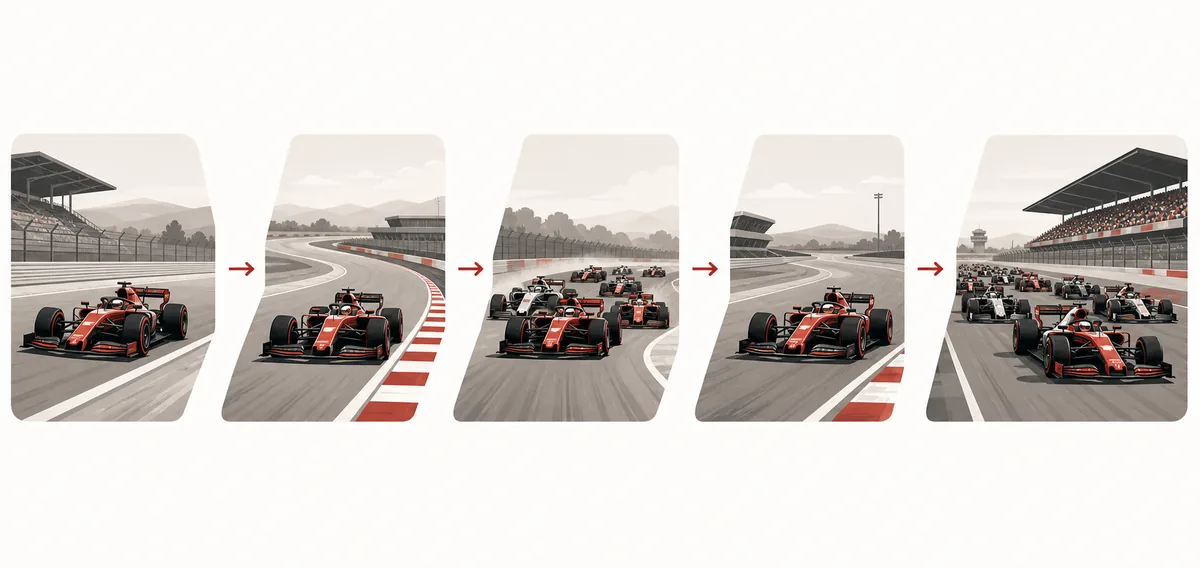
A normal Grand Prix weekend gives teams several practice opportunities before qualifying and the race. A sprint weekend compresses much of that preparation. There is usually one practice session, then sprint qualifying sets the grid for Saturday’s sprint. After the sprint, the regular qualifying session sets the grid for Sunday’s Grand Prix.
That order matters because the sprint is not simply a second version of Sunday. The cars may have different setup priorities, the team has less time to learn the circuit, and a damaged floor or front wing can affect two races instead of one. Drivers also have to manage risk: gaining one place in the sprint may be valuable, but a collision can ruin the rest of the weekend.
The exact timetable and regulations can be updated, so use the official event schedule for the current season. The useful mental model is a compact sequence: one preparation session, sprint qualifying, sprint, Grand Prix qualifying, and the full Grand Prix.
For the difference between Sprint Qualifying and the regular session that sets the Grand Prix grid, compare this weekend flow with our F1 qualifying guide. Sprint Qualifying prepares the Sprint; normal Grand Prix Qualifying prepares Sunday.
| Session | What it decides | Why it matters |
|---|---|---|
| Practice | A first read of the circuit and tyres | There is less practice time than on a normal weekend. |
| Sprint qualifying | The grid for Saturday’s sprint | A mistake affects a points-paying race immediately. |
| Sprint race | Saturday finishing order and sprint points | Drivers race hard but must protect the car. |
| Grand Prix qualifying | The grid for Sunday’s Grand Prix | It is a separate qualifying result from sprint qualifying. |
| Grand Prix | The main race result and full points | The Sunday race remains the central event of the weekend. |
F1 Sprint Race vs a Normal Grand Prix
The easiest way to understand the format is to compare the sprint with the race most fans already know. Both are real Formula 1 races, but they serve different jobs inside the weekend. The sprint is shorter and more compact; the Grand Prix generally offers more room for tyre strategy, pit stops, changing conditions, and recovery after an early setback.
A sprint race is normally run without a planned pit stop. That does not mean tyres and strategy are irrelevant. Drivers still need to manage degradation, defend position, and choose when to attack. However, the shorter distance makes track position and a clean launch more valuable than a long strategic sequence.
The sprint also changes the viewing rhythm. Instead of waiting until Sunday for the first meaningful race, fans get a competitive session earlier. For new viewers, the key distinction is simple: sprint qualifying sets the sprint grid, while Grand Prix qualifying sets the Sunday grid.
| Feature | F1 sprint race | Sunday Grand Prix |
|---|---|---|
| Purpose | A short competitive race inside selected weekends | The main full-distance race of the event |
| Grid source | Sprint qualifying | Regular Grand Prix qualifying |
| Distance | Shorter than the Grand Prix | The longer race distance set by the event |
| Pit-stop plan | Usually a flat-out race without a planned stop | More room for tyre and pit-stop strategy |
| Points | Reduced points for the top eight | Full race points, plus any fastest-lap point when applicable |
| Risk profile | High value per lap and little recovery time | More laps to recover, but greater total exposure |
How Many Points Does an F1 Sprint Race Give?
An F1 sprint awards points to the top eight finishers. The winner receives eight points, then the scale drops one point at a time to eighth place. A driver who finishes outside the top eight does not score sprint points, even though the result can still affect the starting position, team momentum, and the way rivals approach Sunday.
Sprint points count toward both the Drivers’ Championship and the Constructors’ Championship. That gives teams a reason to race seriously, but the value is still lower than a Sunday win. A driver can therefore take a strong sprint result without treating it as a substitute for the Grand Prix.
Sprint qualifying has a different job: it sets the sprint grid rather than awarding the sprint’s finishing points. Do not confuse a qualifying position with a race result. The same weekend can contain a sprint qualifying result, a sprint race result, a Grand Prix qualifying result, and a Grand Prix result.
The lower scale reflects the Sprint’s shorter distance and smaller competitive window compared with the full Grand Prix. It still matters to both championships, but it is not intended to carry the same points value as the main Sunday race.
| Sprint finish | Championship points |
|---|---|
| 1st | 8 points |
| 2nd | 7 points |
| 3rd | 6 points |
| 4th | 5 points |
| 5th | 4 points |
| 6th | 3 points |
| 7th | 2 points |
| 8th | 1 point |
F1 Sprint Rules: Tyres, Parc Ferme, and Incidents
Sprint weekends place more pressure on the first setup decision. With only one practice session, teams have less time to compare tyre behaviour and aerodynamic settings. The parc ferme framework also limits how much a car can be changed once the relevant session begins. The practical effect is that a wrong direction is harder to repair quickly.
Tyre allocation and tyre rules can vary with the current sporting regulations and the event format. A sprint is usually run as a short, hard race rather than a conventional pit-stop contest, but weather, damage, safety-car timing, or an unusual tyre choice can change the picture. Avoid treating a simple no-stop expectation as an absolute rule for every future season.
Incidents are judged under the same sporting framework as other Formula 1 sessions. A driver can receive a penalty for causing a collision, leaving the track, or gaining an advantage. A sprint penalty may affect the sprint result, the next grid, or a later session depending on the decision and the applicable regulations.
- Limited preparation: one practice session leaves less time to discover a setup problem.
- Parc ferme constraints: teams cannot freely redesign the car after the relevant lock-in point.
- Shorter strategic window: track position and the opening laps carry more weight than in a long race.
- Real penalties still apply: the sprint is a championship session, not a penalty-free exhibition.
- Regulations can evolve: check the FIA sporting regulations when a current rule detail matters.
Why Do Teams Approach the Sprint Differently?
The sprint creates a trade-off between immediate points and protecting the car for Sunday. A midfield team may value an aggressive launch because one or two places can be worth a large share of its weekend opportunity. A championship leader may be more cautious if a damaged car would compromise both the sprint and the Grand Prix.
Drivers also have to decide how much information to reveal. A sprint can expose which cars have strong low-fuel pace, which tyres are degrading, and which corners are difficult to defend. That information helps the team before Sunday, but the race itself is still a competitive result, so there is no guarantee that a team will sacrifice the sprint simply to hide its pace.
For viewers, this explains why sprint races can look more aggressive than a normal opening stint. There are fewer laps to wait, fewer opportunities to recover, and a clear points reward near the front. A clean launch, a stable first lap, and avoiding damage are often more valuable than a complicated plan.
- Attack early: there are fewer laps in which to pass, so the first opportunities can be decisive.
- Protect the car: front-wing or floor damage can turn one risky move into a Sunday problem.
- Read the tyres: a short race still reveals degradation and traction clues for the Grand Prix.
- Separate the results: a strong sprint does not automatically create a strong Sunday starting position.
The 2026 F1 Sprint Calendar
Formula 1 and the FIA announced six sprint events for the 2026 season. They are spread across the calendar rather than used at every Grand Prix, which is why a viewer should check the event listing before expecting a Saturday sprint.
The selected venues include a mix of circuits with different racing characteristics. A sprint at a high-speed track can reward qualifying position and traction, while a circuit with limited overtaking may make the first lap and track position even more important. The same format can therefore produce very different racing from one venue to another.
The table below records the announced 2026 sprint venues. Dates and session times should be verified against the official calendar before planning around a particular event.
| 2026 venue | Country | Sprint weekend position |
|---|---|---|
| Shanghai | China | Early-season sprint weekend |
| Miami | United States | Spring sprint weekend |
| Montreal | Canada | Early-summer sprint weekend |
| Silverstone | United Kingdom | Summer sprint weekend |
| Zandvoort | Netherlands | Late-summer sprint weekend |
| Singapore | Singapore | Late-season sprint weekend |
Calendar reference checked on August 2, 2026. This page explains the format and is not a live timing or race-results feed.
What an F1 Sprint Means for Start Practice
A sprint race still begins with a real race launch, so the first seconds are part of the appeal. The grid is smaller in time rather than in cars: drivers must respond to the start signal, choose a clean line, and avoid losing positions before the race settles. For a browser practice tool, the useful part to copy is the visual cue and the discipline of reacting without guessing.
Do not treat an online lights-out timer as a full sprint simulator. It cannot reproduce clutch bite, tyre temperature, steering correction, launch control limits, or the pressure of racing 19 other cars. It can, however, help you practice waiting for the signal and comparing a short series of clean attempts.
If your goal is a better reaction score, keep the device and input method consistent, separate guessed starts from valid results, and judge an average rather than one unusually fast click. The broader F1 context is useful, but the practice result is still a browser measurement with device latency.
Try a clean lights-out drill
Run several attempts on the F1 Start Timer, react only when the signal changes, and compare the average instead of chasing a single lucky score.
Practice with the F1 Start TimerF1 Sprint Race FAQ
What is a sprint race in F1?
It is a shorter, standalone Formula 1 race held on selected Grand Prix weekends, usually on Saturday. It awards points to the top eight finishers and has its own qualifying session and grid.
Is an F1 sprint race the same as qualifying?
No. Sprint qualifying sets the grid for the sprint race. The sprint itself is a race with overtaking, a finishing order, and championship points. Regular qualifying later sets the grid for Sunday’s Grand Prix.
How long is a sprint race in F1?
The sprint is substantially shorter than the Grand Prix and is designed as a compact race rather than a full-distance event. The exact lap count depends on the circuit and the current regulations.
How many points does the F1 sprint winner get?
The sprint winner receives eight championship points. Points are awarded to the top eight, descending from eight for first to one for eighth.
Does every F1 weekend have a sprint race?
No. Sprint races are held at selected events. Check the current Formula 1 calendar because the venues and session order are not the same for every Grand Prix.
Can teams pit during an F1 sprint?
They can pit when the rules and circumstances allow it, but the short format usually makes a planned pit-stop strategy less common than in the Grand Prix. Damage, weather, or an unusual tyre situation can change that choice.
Does the sprint result decide the Sunday grid?
No. The sprint has its own result, while the regular Grand Prix qualifying session sets the Sunday starting grid. A sprint result can still affect penalties, momentum, and the information teams take into Sunday.
Is the F1 sprint race worth championship points?
Yes. Sprint points count toward both the Drivers’ Championship and Constructors’ Championship, although the winner receives fewer points than a Sunday Grand Prix winner.
Why does an F1 sprint award fewer points than a Grand Prix?
The Sprint is a shorter race with a smaller distance and less time to score than the Sunday Grand Prix, so its points scale is lower. The points still count toward both the Drivers’ and Constructors’ Championships.
Sources and scope
The format summary and 2026 venue list are based on the official Formula 1 beginner’s guide to the Sprint and the announced 2026 Sprint calendar.
For rule details that can change between seasons, consult the current FIA Formula 1 regulations. This article is an independent explainer, not an official timing, results, or regulatory service.
The start-practice section describes browser reaction practice only. It does not claim to reproduce a real F1 launch, clutch response, tyre grip, driver workload, or official race timing.