F1 Delta Time Explained: What + and - Mean in Qualifying
A practical guide to lap delta, sector gaps, reference laps, positive and negative values, and the limits of timing graphics.


What Does F1 Delta Time Mean?
In Formula 1 timing, a delta is a difference between two measurements. An F1 delta time usually compares a current lap, sector, or target with a reference and reports how far ahead or behind it is. It is not a separate lap-time format; it is a comparison layered on top of the time already being measured.
If the reference is 1:34.800 and the current lap is 1:35.050, the current lap is 0.250 seconds slower. A current lap of 1:34.550 is 0.250 seconds faster. Timing screens may show those results as +0.250 and -0.250, but the reference and subtraction order still need to be checked.
| Type | Compares | Question it answers |
|---|---|---|
| Lap delta | Current lap and reference lap | Is the lap faster? |
| Sector delta | One sector and its reference | Where was time gained? |
| Race-control delta | Pace and a required target | Is the target being respected? |
How to Read Positive and Negative Delta Values
Under the common current-minus-reference format, a negative value means the current time is lower and therefore faster than the reference. A positive value means the current time is higher and therefore slower. A value of 0.000 means the displayed measurements are equal after rounding, not necessarily identical underneath.
Do not treat the sign as universal. Some displays use the reverse subtraction order, while a safety procedure may show a target or minimum delta rather than outright performance. Read labels such as ‘to pole’, ‘to best’, ‘gap’, or ‘target’ before interpreting the color or arrow.
| Value | Common reading | First check |
|---|---|---|
| -0.250 s | 250 ms below the reference | The display's subtraction order |
| +0.250 s | 250 ms above the reference | Whether the reference is pole, best, or target |
| 0.000 s | Equal after rounding | The precision and refresh timing |
- Negative is usually faster: when current time minus reference time is being shown.
- Positive is usually slower: but a control delta may describe compliance with a target instead.
- The label wins: the benchmark matters more than the color alone.
The Reference Lap Behind the Number
A delta is only meaningful when you know its reference. In qualifying, the benchmark might be a driver's personal best, a teammate, the fastest completed lap, provisional pole, or an ideal lap built from the best sectors. A driver can be -0.200 to a personal best but +0.400 to pole: improving, yet still four tenths away from the current leader.
The reference may change during a session. When another driver goes faster, the same lap can move from a small negative value to a positive gap against pole. Track evolution makes this common because grip, tire preparation, traffic, and run timing improve at different rates. An ideal lap is a diagnostic possibility, not proof that all best sectors could have been combined.
| Reference | Best use | Limitation |
|---|---|---|
| Personal best | Measure improvement | Conditions may differ |
| Provisional pole | Show the session gap | It can move after a faster lap |
| Teammate | Compare relative pace | Setups and traffic may differ |
| Ideal lap | Find theoretical gains | Sectors may not join on one lap |
Lap Delta vs Sector Delta
A lap delta gives the headline result; sector deltas show where it happened. If a reference lap has sectors of 29.4, 31.1, and 34.3 seconds, while the current lap has 29.5, 30.9, and 34.2, the changes are +0.1, -0.2, and -0.1 seconds. Together they produce a -0.2-second lap delta.
This pattern describes a mixed lap: a small loss in sector one was outweighed by gains in sectors two and three. It does not identify the cause by itself. A traction exit, tire temperature, traffic, a tow, or a timing-line boundary can influence several corners around one sector. Use the delta to locate the question, then check the conditions.
| Reference | Current | Delta |
|---|---|---|
| S1: 29.4 s | S1: 29.5 s | +0.1 s |
| S2: 31.1 s | S2: 30.9 s | -0.2 s |
| S3: 34.3 s | S3: 34.2 s | -0.1 s |
| Lap: 94.8 s | Lap: 94.6 s | -0.2 s |
How F1 Delta Time Appears in Qualifying
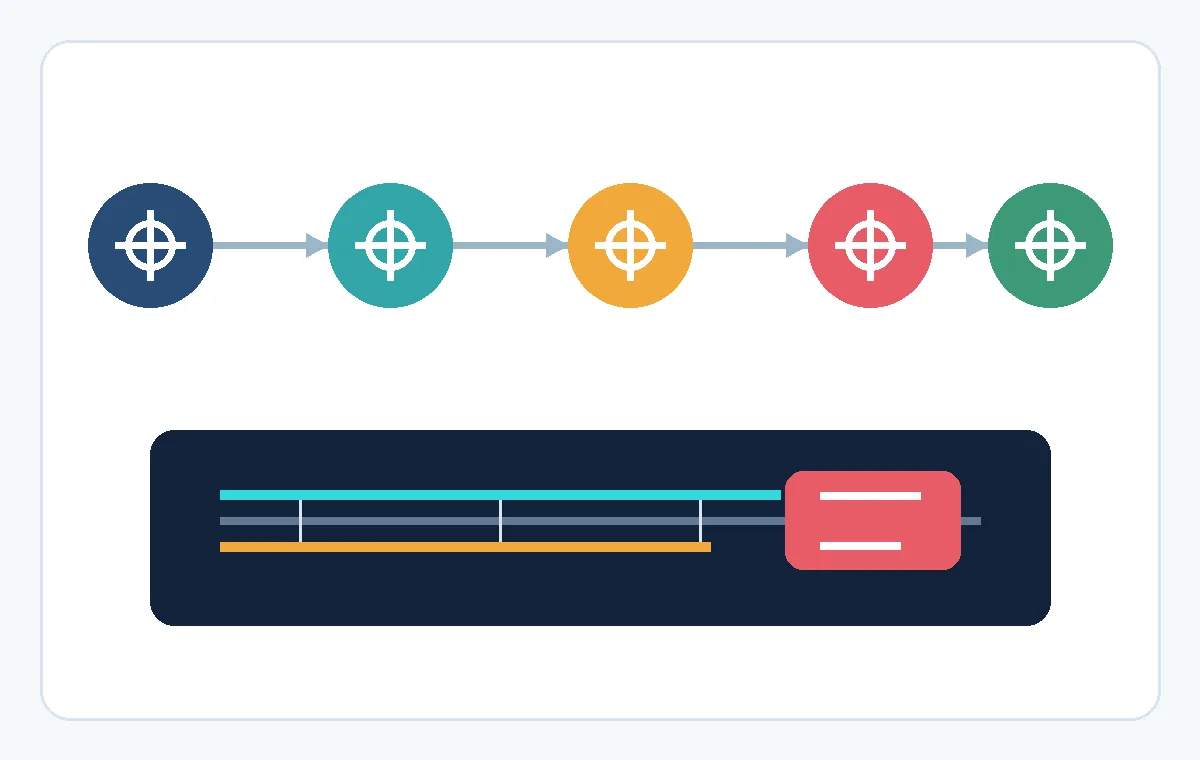
During a qualifying lap, a timing graphic can update against a teammate, the fastest lap, or provisional pole as the car crosses sector lines. A negative sector delta shows an advantage against that chosen reference under the display's convention; a positive value shows a deficit. The same driver can therefore have different deltas on different screens.
A delta is not a final qualifying classification. The lap must remain valid, and traffic, flags, tire preparation, fuel, track grip, or a deleted lap can change the result. See our F1 qualifying guide and starting grid explanation for how the timed order becomes a race grid.
| Graphic | Useful clue | Not proof of |
|---|---|---|
| Sector -0.12 s | Ahead of the chosen sector reference | A faster full lap |
| Gap grows to +0.35 s | Time is being lost to the reference | The exact cause |
| Reference changes | The benchmark improved | A sudden change in car pace |
Performance Delta vs Race-Control or VSC Delta
A performance delta compares a lap or sector with a benchmark. A race-control delta can instead compare observed pace with a required target. During a controlled condition such as a Virtual Safety Car procedure, the number is about respecting the prescribed pace, not simply beating the car ahead.
That is why identical-looking signs can mean different things. In one graphic, -0.4 seconds may mean faster than a lap reference. In another, the driver is trying to stay within a controlled target. For safety procedures, penalties, and official definitions, use the current FIA Formula 1 regulations and event documents.
| Context | Reference | Read it as |
|---|---|---|
| Qualifying pace | Lap, sector, or pole benchmark | Relative performance |
| Race gap | Another car's timing position | Separation, not a cause |
| Controlled pace | Required race-control target | Compliance information |
A Simple F1 Delta Time Example
Use a reference of 1:34.800. A current lap of 1:35.050 gives 1:35.050 - 1:34.800 = +0.250 seconds, so it is a quarter-second slower under the common convention. A current lap of 1:34.550 gives -0.250 seconds, so it is a quarter-second faster.
The same logic works for sectors. Add +0.1, -0.2, and -0.1 seconds and the total is -0.2 seconds. In real coverage, ask whether the laps used the same tire, fuel, traffic conditions, track grip, and valid track limits. Delta shows what changed; it does not fully explain why.
| Step | Calculation | Result |
|---|---|---|
| Reference | 1:34.800 | Benchmark |
| Slower lap | 1:35.050 - 1:34.800 | +0.250 s |
| Faster lap | 1:34.550 - 1:34.800 | -0.250 s |
- Name the reference: best lap, pole lap, teammate, sector, or control target.
- Read the sign: apply the display's subtraction convention.
- Check the run: compare tires, fuel, flags, traffic, and lap validity.
Common F1 Delta Time Mistakes and Limits
The most common mistake is treating every number in seconds as the same score. A lap delta, a gap to the car ahead, and a race-control target describe different relationships. If the screen does not identify the reference, the number is incomplete rather than self-explanatory.
Do not confuse live telemetry delta with an F1 game setting, a stopwatch, or a reaction score. A fast sector can still belong to a lap that is deleted, and a tiny change can come from rounding or changing track conditions. For lights-out practice, use the site's F1 Start Timer; for the broader timing vocabulary, see F1 stopwatch vs start timer.
- Reference first: -0.2 to a personal best is not -0.2 to provisional pole.
- Validity matters: track limits and flags can remove an apparently strong comparison.
- Trend beats one number: several comparable laps are more useful than one tiny live swing.
F1 Delta Time FAQ
Sources and scope
This fan-facing guide uses simplified examples. Broadcasts, teams, and timing providers may label references or signs differently, so the on-screen legend remains important.
For qualifying context, see the official Formula 1 weekend guide. For controlled-speed procedures and sporting definitions, consult the current FIA Formula 1 regulations and event documents.
This site is an independent fan-made practice resource and is not affiliated with Formula 1, FIA, or any racing team.
Last updated: September 6, 2026