Blue Flag F1: Meaning, Rules and Penalties Explained
A clear guide to why drivers see blue flags, how backmarkers let leaders through, and why the signal means something slightly different in a race, practice session, and at pit exit.

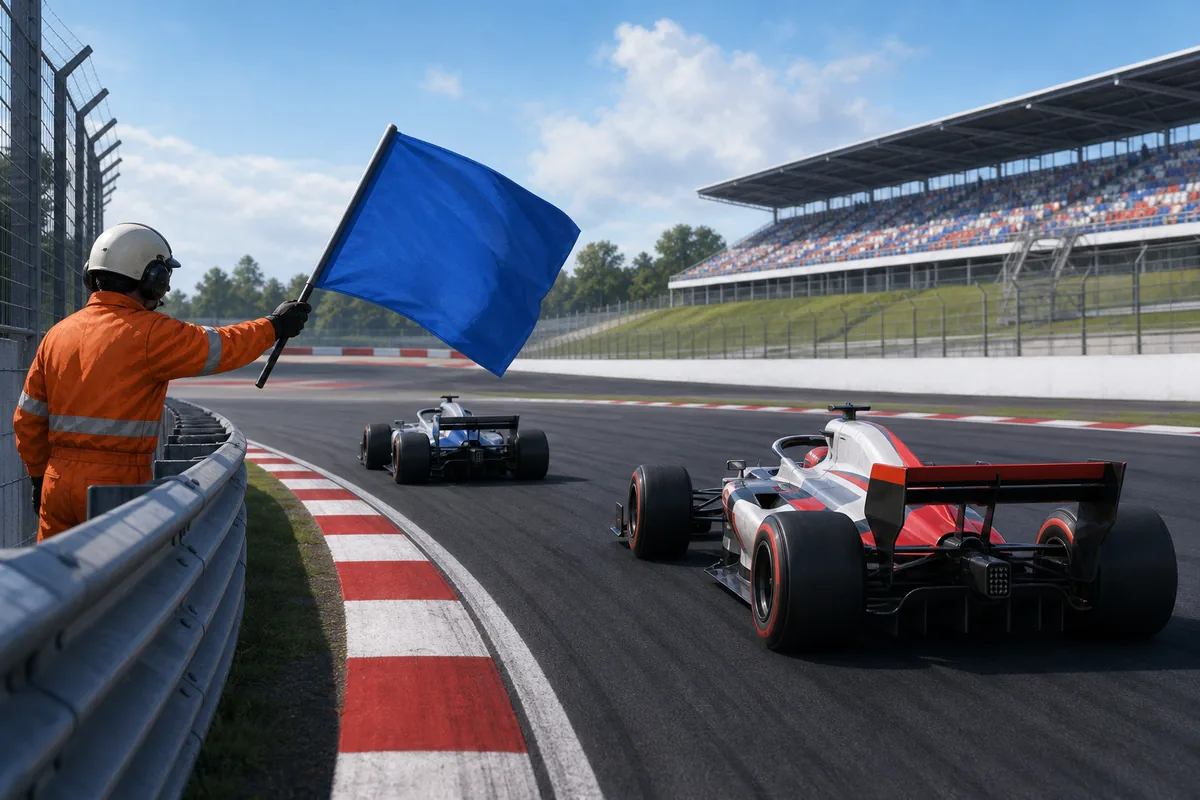
What Does a Blue Flag Mean in F1?
The blue flag in F1 is a warning that a faster car is approaching from behind. In a race, it is directed at a car that is about to fall a full lap behind the leaders. The slower driver must make it possible for the faster car to pass at the earliest opportunity without creating an unpredictable or unsafe move.
Being shown the flag does not mean the slower driver has been disqualified or must stop. It means the driver is no longer fighting the approaching car for the same track position. The approaching leader is completing a later lap, while the backmarker is still completing an earlier one.
This distinction explains why a driver may defend normally against a rival on the same lap but must cooperate when the blue-flag system identifies a lapping situation. Trackside marshals, electronic light panels, cockpit information and team radio can all help communicate the warning.
| Situation | Blue flag message | Driver response |
|---|---|---|
| Race | A leader is about to lap the car | Allow the faster car through at the earliest opportunity |
| Practice or qualifying | A much faster car is approaching | Avoid impeding the faster lap |
| Pit exit | Traffic is approaching on the circuit | Rejoin carefully and do not interfere |
Blue Flag F1 Rules in 2026
The current FIA sporting rules require a driver who is about to be lapped to allow the following car to pass at the earliest opportunity. If the driver ignores three successive blue-flag indications, the incident is reported to the stewards. The regulation creates an obligation to respond, but it does not require a dangerous instant swerve.
Race control uses timing gaps and track position to manage blue-flag indications. The practical trigger can depend on the control system and the situation, so a fixed gap quoted in an older article should not be treated as a timeless rule. The durable rule is the obligation shown in the current FIA regulations: respond promptly and facilitate the pass.
The signal protects the race at both ends. Leaders should not lose large amounts of time behind cars running a lap down, while backmarkers need enough predictability to let them pass safely. That is why the wording focuses on the earliest opportunity, not simply the next metre of track.
- One warning: the driver should prepare a predictable pass point and listen to team instructions.
- Successive warnings: continued delay increases the risk that race control refers the incident.
- Three ignored indications: the matter is reported to the stewards and a penalty may follow.
Blue Flags in a Race, Practice and at Pit Exit
The same blue colour carries related but not identical instructions across a Grand Prix weekend. During the race, lap status is central. During practice and qualifying, the main concern is avoiding interference with a driver on a much faster lap. At pit exit, the signal is a traffic warning.
A practice-session blue flag does not automatically mean the slower car is one lap down. A driver may be cooling tyres, preparing a lap or returning to the pits while another car is on a fast run. The safer interpretation is: a significantly faster car is arriving, so stay predictable and do not impede it.
At pit exit, a stationary blue flag or flashing blue light warns that cars on the circuit are approaching at speed. The exiting driver remains responsible for respecting the pit-exit line and joining without forcing on-track traffic into an avoidable reaction.
| Context | Is it about being lapped? | Main purpose |
|---|---|---|
| Race | Usually yes | Let a car on a later lap pass |
| Practice | Not necessarily | Warn of a much faster approaching car |
| Qualifying | Not necessarily | Protect a driver's flying lap from impeding |
| Pit exit | No | Warn the exiting driver about live track traffic |
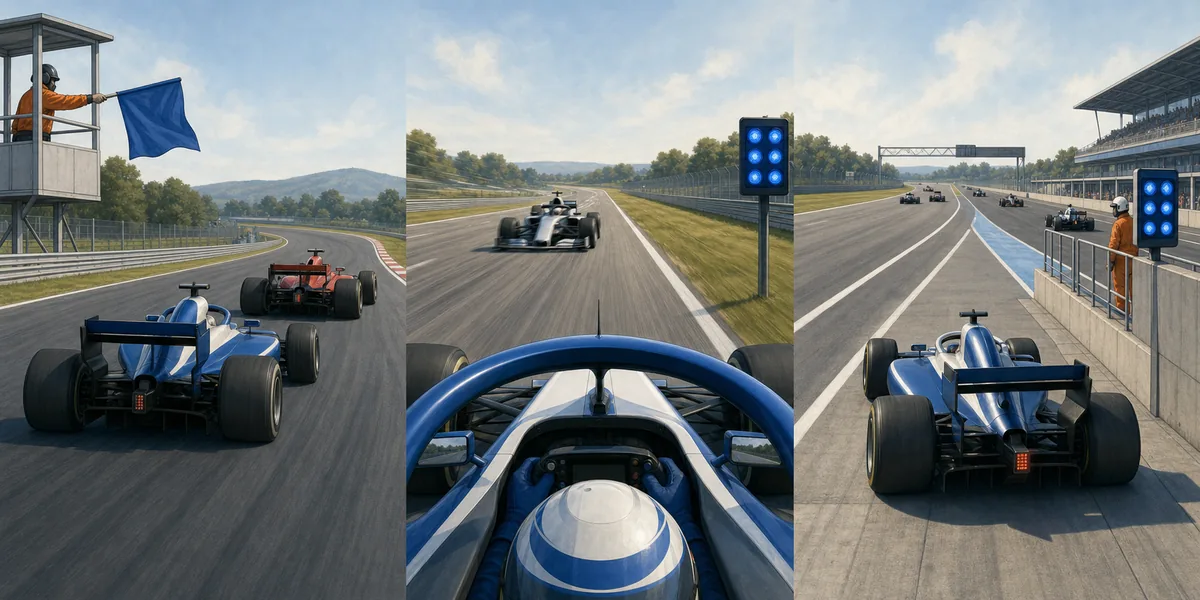
How Should a Lapped Car Let a Faster F1 Car Pass?
The safest response is predictable cooperation. The slower driver should identify a suitable straight, corner exit or other low-risk point, communicate through normal car positioning, and avoid changing direction at the last moment. A sudden dive off the racing line can be harder for the leader to read than a controlled lift in a known place.
The backmarker still has a race to finish. Yielding costs time, can reduce tyre temperature and may affect a nearby battle with another lapped car. Even so, once the blue-flag instruction applies, protecting that separate fight does not justify holding up a leader.
For viewers, the cleanest pass often looks uneventful: the slower car stays predictable, leaves room or eases off briefly, and the faster car completes the move. The goal is not a dramatic overtake; it is minimum delay and minimum risk for both cars.
- Be predictable: choose a clear place and avoid a late change of line.
- Facilitate, do not race: the approaching car is on a later lap, not fighting for the same position.
- Keep control: do not slow abruptly in a blind or high-risk part of the circuit.
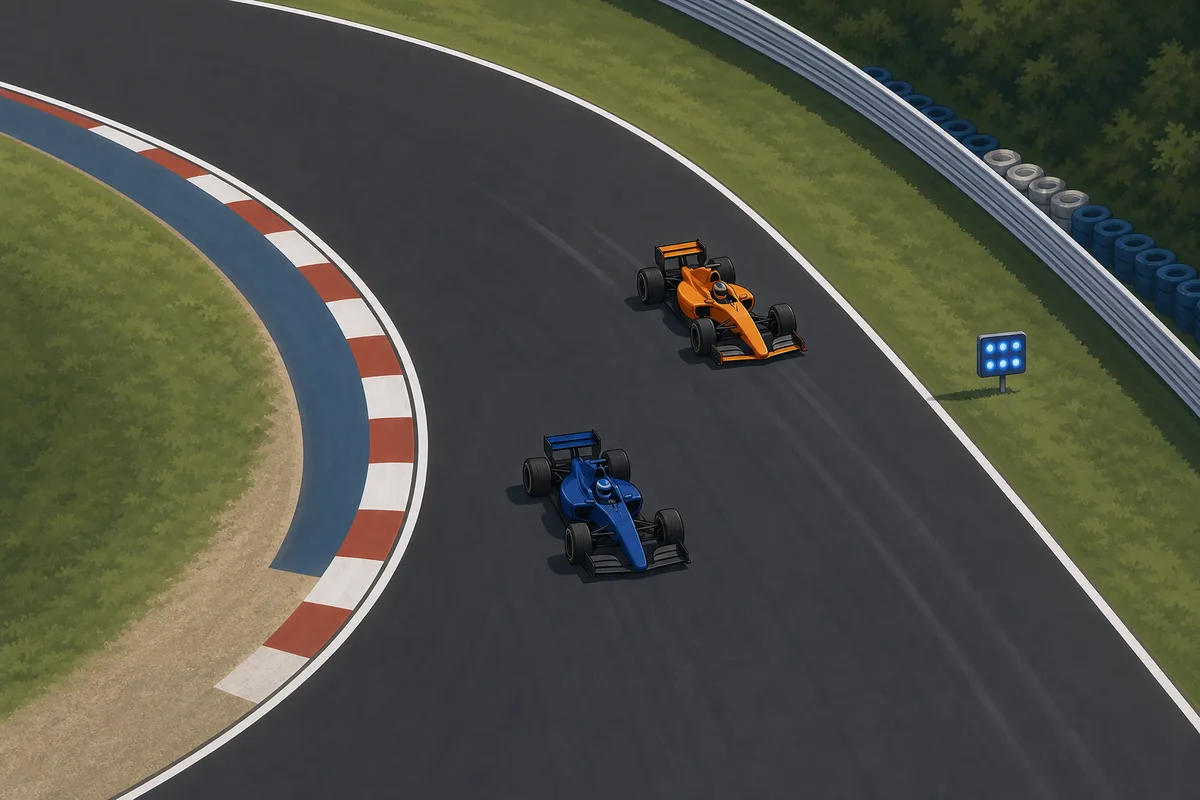
What Is the Penalty for Ignoring Blue Flags in F1?
There is no single automatic time value that applies to every blue-flag incident. The current rule says that ignoring three successive indications is reported to the stewards. They can then consider how long the faster car was delayed, whether the conduct was unsafe, and whether other competitors were affected.
Possible consequences include a time penalty or another sporting sanction appropriate to the incident. Commentary sometimes compresses this into ‘three blue flags equals a penalty,’ but the more accurate explanation is that three ignored indications trigger steward involvement; the exact sanction depends on the case and the regulations in force.
| Question | Accurate answer | Common misconception |
|---|---|---|
| Is the first blue flag a penalty? | No; it is an instruction or warning | Every flag instantly adds time |
| What happens after three are ignored? | The incident is reported to the stewards | The same fixed penalty is automatic in every case |
| Can context matter? | Yes; delay, safety and sporting effect can be considered | Only the number of flags matters |
Blue Flags, Lapped Cars and Unlapping Behind the Safety Car
A car becomes lapped when the leader catches and passes it, leaving it one full race lap behind. The blue flag manages that pass under normal racing conditions. It does not erase the lost lap, change the classification by itself, or give the lapped driver permission to overtake the field later.
Unlapping behind the Safety Car is a separate controlled procedure. Race control may issue a specific official message that allows eligible lapped cars to pass cars on the lead lap and the Safety Car. Drivers must follow that message and the current Safety Car rule; a normal blue flag is not permission to unlap themselves.
This separation also keeps the keyword boundary clear: the F1 formation lap happens before the start, while lapping and blue flags happen after racing is under way. For the lights-out sequence itself, see the guide to F1 starting lights. For the full neutralization procedure, read the F1 safety car guide.
F1 Blue Flag FAQ
Official Sources and Scope
Rule wording was checked on July 25, 2026 against the current FIA 2026 Formula 1 Sporting Regulations, Issue 7.
Formula 1's official beginner's guide to racing flags and F1 glossary provide the fan-facing definitions. This independent site is not affiliated with Formula 1 or the FIA.
Last updated: July 25, 2026