F1 Safety Car Explained: Rules, VSC, Restarts and Strategy
A practical guide to when the safety car comes out, how the virtual safety car differs, what happens at a restart, and why pit strategy changes.

What Is the F1 Safety Car?
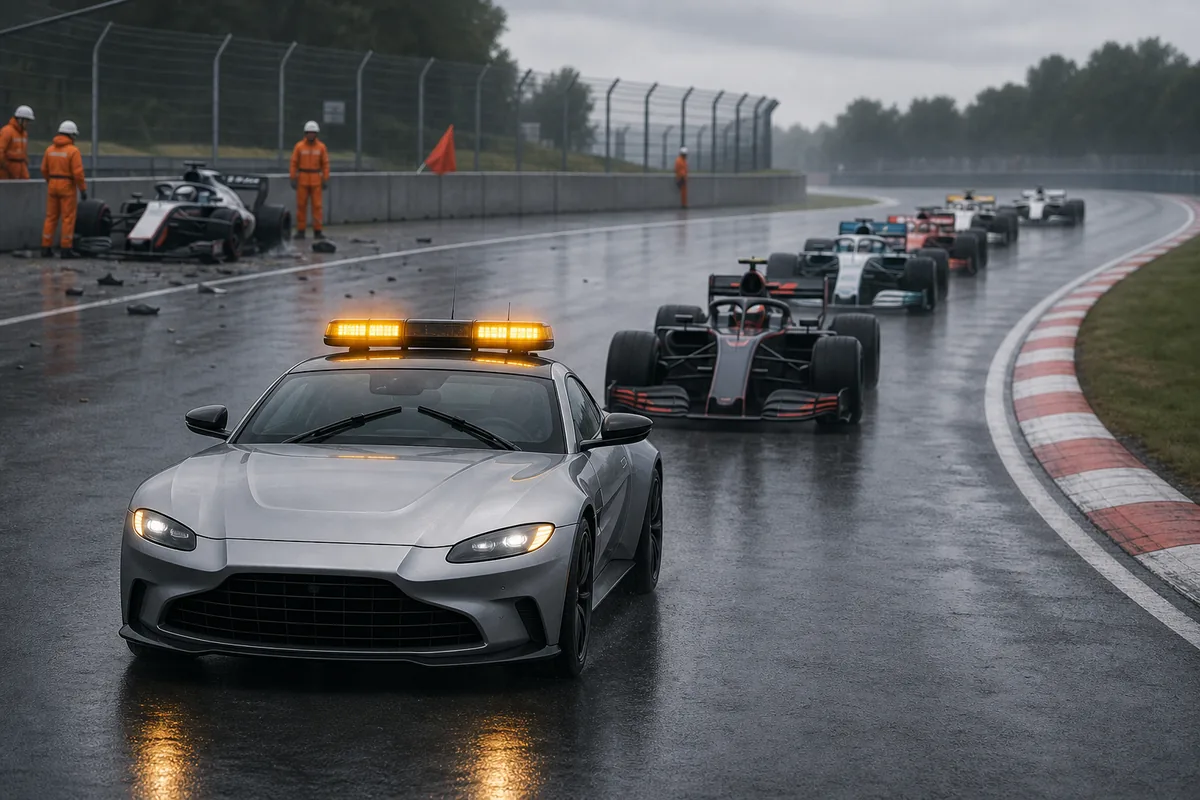
The F1 safety car is a physical road car that leads the field when an incident, debris, poor visibility, or another hazard means drivers cannot safely continue at racing speed. It neutralizes the Grand Prix without stopping the session, giving marshals and recovery crews a safer working environment.
The important idea is controlled speed and a predictable order. Drivers slow down, queue behind the safety car, and follow race-control signals until the circuit is ready. Unlike a red flag, the race remains live and the laps continue under the applicable sporting regulations.
That is why the safety car can change a Grand Prix in seconds. The field compresses, large gaps disappear, and a pit stop that would normally cost a full green-flag time loss can become more attractive. The restart then creates a short, high-pressure race inside the race.
The simple definition
A physical safety car slows and leads the field while race control manages a hazard. It is a neutralization, not a complete restart or a replacement for the race.
When Is the Safety Car Deployed?
Race control considers a physical safety car when local yellow flags or a virtual safety car are not enough to protect drivers and track workers. A crashed car in a dangerous position, substantial debris, recovery equipment near the racing line, or a sudden loss of visibility can all make a full-field neutralization appropriate.
The fact that there is a crash does not automatically mean the safety car appears. Officials weigh the location of the hazard, the available escape area, the weather, the speed of approaching cars, and how quickly marshals can work. A small incident behind a barrier may need only local flags; a car stranded in a high-speed section may need much more control.
Once the safety-car procedure is active, drivers must follow the current messages, flags, delta information, and instructions from race control. Overtaking is normally prohibited, with only the exceptions or explicit permissions defined by the regulations.
- Track hazard: a stopped car, debris, damaged barrier, or recovery vehicle creates a risk.
- Worker protection: marshals need a controlled-speed window to reach and clear the incident.
- Visibility or weather: rain, spray, or a blocked sight line can make racing speed unsafe.
- Race control judgment: officials choose the least disruptive procedure that still protects the circuit.
F1 Safety Car vs Virtual Safety Car
The virtual safety car is a digital pace-control procedure. There is no physical road car at the front of the field; instead, drivers must slow to a prescribed delta and remain within the required time limits. Because the cars do not normally bunch behind one leader, the competitive gaps are partly preserved.
A physical safety car has a stronger sporting effect. The lead car sets the order on track and the rest of the field closes up behind it. That can erase a comfortable lead, give lapped cars a controlled opportunity to be managed, and make a restart feel like a short sprint.
Both procedures are neutralizations, not invitations to drive normally at reduced speed. Drivers still have to respect flags, race-control messages, the delta, and overtaking restrictions. The exact procedure follows the regulations in force for the event.
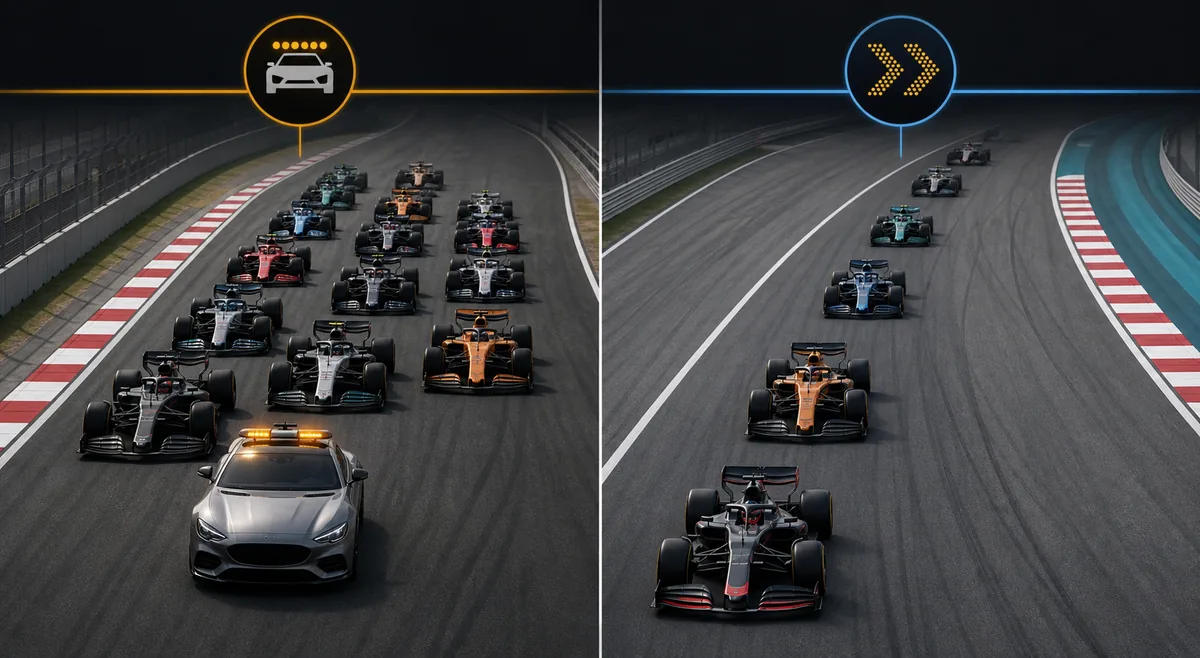
| Situation | Physical safety car | Virtual safety car |
|---|---|---|
| Lead car | A road car leads the field | No physical lead car |
| Field shape | Cars usually bunch together | Gaps are more likely to remain |
| Driver control | Follow the car, flags and messages | Follow the delta and messages |
| Restart effect | Often creates a close restart | Racing resumes without the same queue |
How Does an F1 Safety Car Restart Work?
A restart begins only after race control is satisfied that the hazard has been handled. The order behind the safety car is controlled, and drivers cannot simply decide that the race has returned to normal. Timing boards, lights, flags, radio messages, and the published procedure work together.
When the safety-car period ends, the safety car enters the pit lane according to the current procedure and the field is released back to racing conditions. The leading driver manages the pace within the rules, while every driver tries to keep tyres and brakes in the right operating window without making a dangerous move.
Lapped cars are a separate question. They do not automatically pass the field whenever the safety car appears. Race control may issue a specific message allowing eligible cars to unlap themselves, and drivers must follow that instruction rather than relying on commentary shorthand.
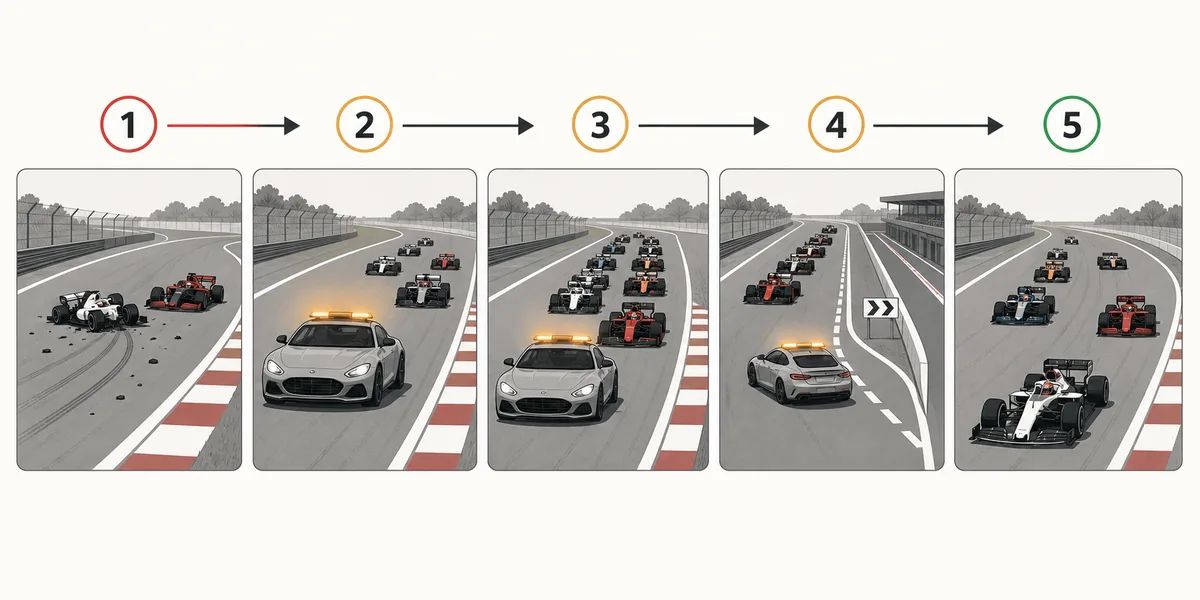
- 1. Incident: Race control identifies a hazard that needs more than local flags.
- 2. Neutralization: The safety car leads the field and drivers follow the required pace.
- 3. Field control: The order is stabilized while marshals clear the circuit.
- 4. Release preparation: Race control confirms the end of the safety-car procedure.
- 5. Racing resumes: Green signals and official messages return the field to racing conditions.
What Does the Safety Car Change for Strategy?
The biggest strategic change is the reduced relative cost of a pit stop. Under green flags, a driver can lose many seconds while entering the pit lane, stopping, and rejoining. When the field is neutralized, the leader may have less of a gap to lose, so teams often reassess whether fresh tyres are worth the track-position risk.
It is not a free stop. Pit-lane entry and exit remain important, the car can rejoin in traffic, and the team may have to serve a penalty or avoid an unsafe release. Tyres can also cool during the neutralization, making the first two corners after the restart difficult even when the pit-stop calculation looked attractive.
Teams therefore balance position, tyre age, compound choice, remaining race distance, and the chance of another neutralization. A safety car can help one driver who pits at the right moment and hurt another who has just committed to the opposite plan.
| Decision | Why it matters |
|---|---|
| Pit now | The time loss is smaller relative to the compressed field. |
| Stay out | Track position may be more valuable than fresh tyres. |
| Choose a tyre | A compound must work after a slow, cool restart lap. |
| Protect the restart | A driver needs space, temperature and a predictable car. |
F1 Safety Car Rules to Watch
The headline rules are simple, but the details matter. Drivers must obey the safety-car boards, flags, delta information, and official messages. The current 2026 sporting regulations describe a normal following distance behind the physical safety car of no more than ten car lengths, with special provisions when visibility is poor; the exact rule text should always be checked against the current issue.
The same caution applies to overtaking, pit-lane behavior, lapped cars, and the restart line. Commentary often compresses a complex procedure into one sentence, while the sporting regulations distinguish between what is normally prohibited and what race control may explicitly authorize.
The site's F1 red flag guide explains the stronger session suspension and how it differs from a Safety Car or VSC.
- Overtaking: normally forbidden during the neutralization unless the regulations or an official message create an exception.
- Following distance: keep the regulated gap to the physical safety car and respond to poor-visibility instructions.
- Pit lane: a stop is allowed only through the normal pit-entry, pit-exit and release procedures.
- Lapped cars: unlapping requires the applicable race-control message; it is not automatic.
- Restart: racing returns only after the official lights, flags and messages indicate the procedure is complete.
F1 Safety Car FAQ
What is the safety car in F1?
It is a physical road car that leads the field at controlled speed when an incident or condition makes full-speed racing unsafe. The race is neutralized but not normally stopped.
What is the difference between the Safety Car and VSC?
The physical Safety Car leads the field and usually bunches the cars together. The VSC has no lead car; drivers slow to a prescribed delta, so gaps are more likely to remain.
Can F1 drivers overtake behind the safety car?
Normally no. Drivers must follow the current regulations and race-control messages, including any specific exception or permission that applies.
Why does the field bunch up behind the F1 safety car?
Cars that were separated by different racing speeds are brought into a controlled queue behind one physical car. That reduces gaps and sets up a closer restart.
Can drivers pit during a safety-car period?
Usually yes, subject to the pit-lane procedure and any penalties or restrictions. The strategic value is that the relative time loss can be smaller than under green flags.
Do lapped cars always get to unlap themselves?
No. Unlapping is controlled by race-control instructions and the regulations for the event; the appearance of the safety car alone is not automatic permission.
When does racing resume after the safety car?
Racing resumes only after the hazard is cleared and the official end-of-safety-car procedure is communicated through the applicable lights, flags and messages.
Official Sources and Scope
The rule notes were checked on August 18, 2026 against the current FIA 2026 Formula 1 Sporting Regulations, Section B. Regulations and race-control procedures can change, so the current event documents take priority.
For fan-facing background, compare the official Formula 1 glossary and the FIA Formula 1 regulations page. F1 Start Timer is an independent explainer site and is not affiliated with Formula 1 or the FIA.