F1 Points System: How Grand Prix and Sprint Points Work
A clear guide to the points table, Sprint scoring, team totals, countback and the rules that can change a result.

How the F1 Points System Works
The F1 points system converts classified race results into the Drivers' and Constructors' Championships. A driver keeps their individual points; a team adds the points credited to both of its cars.
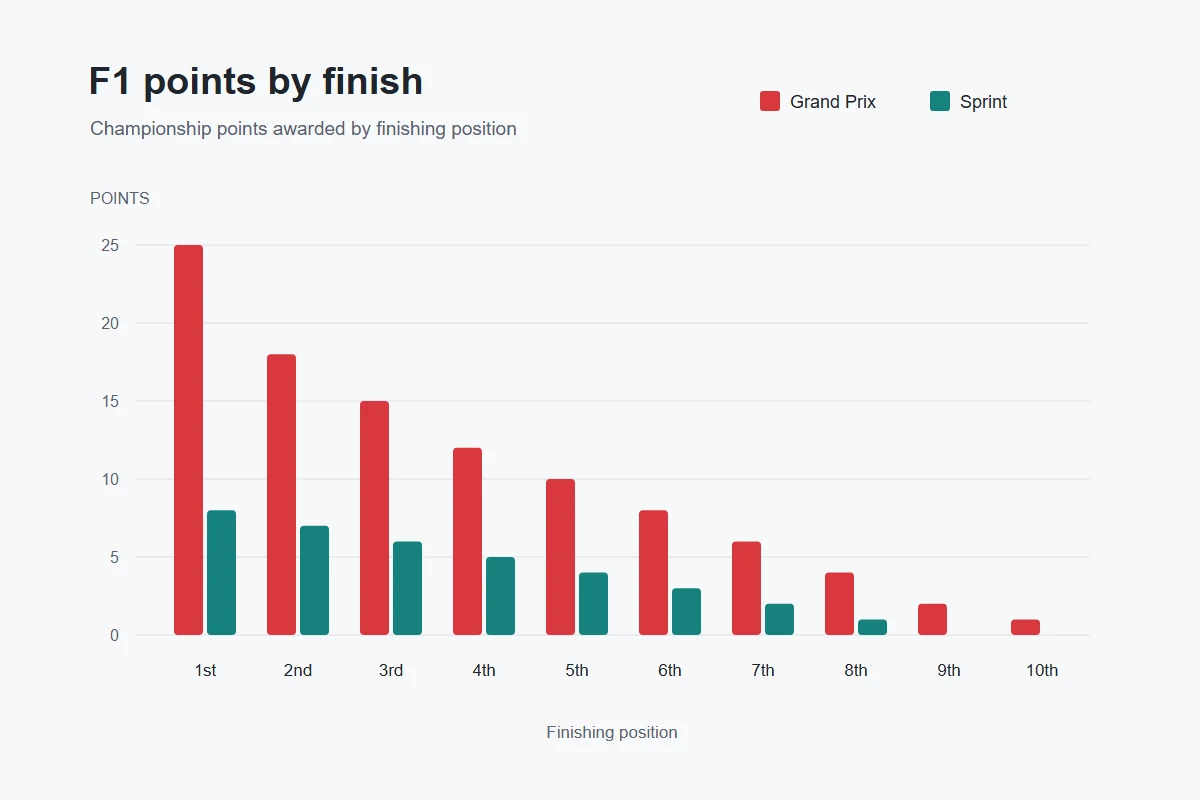
A standard Grand Prix pays the top ten from 25 points for first to 1 for tenth. A Sprint pays the top eight from 8 to 1. Qualifying and pole position carry no separate championship point. The final award follows the official classification and the regulations for that season.
At a glance
Grand Prix: points for the top 10, with 25 for a win. Sprint: points for the top 8, with 8 for a win. Both feed both championships; fastest lap has no bonus point.
Grand Prix Points Table
The standard full-distance Grand Prix table awards 25, 18 and 15 points to the top three, then 12, 10, 8, 6, 4, 2 and 1 through tenth. Positions outside the top ten score zero.
The gaps are uneven: moving from second to first is worth seven points, while ninth to tenth is worth one. Apply the table to the official classification after penalties. A retired car can still be classified if it meets the rules' distance criteria; interrupted races may use a reduced award.
Read the final classification
A post-race penalty can change the order and the points. Use the final official result, not provisional live timing.
| Grand Prix position | Points | What the place earns |
|---|---|---|
| 1st | 25 | Winner |
| 2nd | 18 | Seven fewer than first |
| 3rd | 15 | Final podium place |
| 4th | 12 | Outside the podium |
| 5th | 10 | Double digits |
| 6th | 8 | Eight points |
| 7th | 6 | Six points |
| 8th | 4 | Four points |
| 9th | 2 | Two points |
| 10th | 1 | Last scoring place |
| 11th or lower | 0 | No points |
F1 Sprint Points
A Sprint is a separate short race held at selected events. The top eight score 8, 7, 6, 5, 4, 3, 2 and 1; ninth and lower score zero. These points join the same driver and team standings as Grand Prix points.
Sprint qualifying sets the Sprint grid; regular qualifying sets the Grand Prix grid. A Sprint win plus second in the Grand Prix is 8 + 18 = 26 points before adjustments. Check the current calendar because not every weekend has a Sprint.
| Sprint position | Points | Grand Prix comparison |
|---|---|---|
| 1st | 8 | Sprint winner |
| 2nd | 7 | Seven points |
| 3rd | 6 | Six points |
| 4th | 5 | Five points |
| 5th | 4 | Four points |
| 6th | 3 | Three points |
| 7th | 2 | Two points |
| 8th | 1 | Last scoring place |
| 9th or lower | 0 | No points |
How Driver and Team Points Add Up
The Drivers' Championship adds each driver's own Grand Prix and Sprint points. A driver keeps points already earned if they change teams; a no-score weekend does not erase earlier results.
The Constructors' Championship adds the points credited to both cars. If one driver wins and the other finishes sixth, the team scores 25 + 8 = 33 before any adjustment. Two cars finishing outside the scoring places add zero.
Worked example
Second and ninth in a Grand Prix gives a team 18 + 2 = 20 points. A third-place Sprint adds 6 to both relevant totals.
- Driver total. Add one driver's awarded results.
- Constructor total. Combine both cars' points.
- Penalties matter. A revised result can change the total.
- No pole bonus. Qualifying position earns no point.
Ties, Penalties and Interrupted Races
A season tie is decided by countback: compare wins, then second places, then third places and further results. Consult the applicable FIA regulations for the season if the listed results still leave a tie.
Use the final classification after steward decisions. A time penalty or disqualification can change championship points; a driver's licence penalty point is a separate sanction and is not a race point.
An interrupted or shortened race can receive a reduced award under the season's rules. Distance completed and whether the race resumes matter, and historical online tables may be out of date. A retired car may still be classified if it meets the distance criteria.
- Confirm the session. Choose the Grand Prix or Sprint table.
- Check the final order. Include penalties and exclusions.
- Check race status. Use season rules for a shortened event.
- Add totals. Calculate drivers and teams separately.
Fastest Lap and Changes to the Points System
There is no fastest-lap championship bonus under the current rules. The point was removed from the 2025 season; a fastest lap may appear in results but does not increase either points total.
F1 has changed its scoring scale over time, and Sprint points were introduced later. For historical comparisons, use the rules from that season rather than applying today's table to every old result.
Common misconception
A fastest lap can score zero championship points. The classified position determines the award.
How to Read an F1 Championship Standings Table
The standings points column is cumulative, not the score from the latest race. Compare each driver's event points with their rivals, and remember that a Sprint weekend adds another scoring session.
For a quick calculation, record the final classified positions, use the correct session table, then add each driver's results. For a constructor, total both cars. If a decision is pending or the race was shortened, wait for the official result and season rules.
- Separate sessions. Keep Sprint and Grand Prix results apart.
- Use final positions. Apply the official classification.
- Total the driver. Add the driver's eligible scores.
- Total the team. Combine both cars' points.
- Check the season. Use current rules for shortened races.
F1 Points System FAQ
Sources and update note
The standard scoring tables and race classification are governed by the current FIA Formula 1 regulations. Regulations can change; consult the version for the relevant season and event for interrupted-race, Sprint and countback details. This independent explainer is not an official live standings service.
Last updated: September 28, 2026