F1 Track Limits Explained: Rules and Penalties
A clear guide to the white line, four-wheel rule, deleted laps, warning flags and race penalties.

What Are F1 Track Limits?
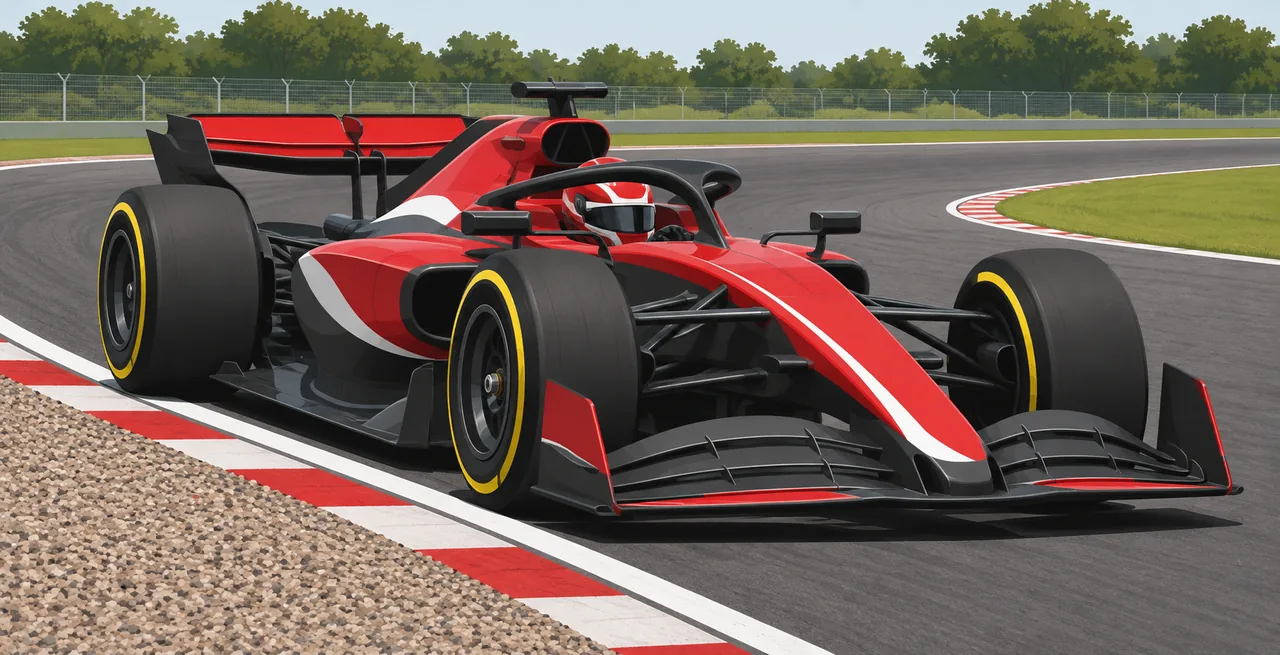
F1 track limits are the edges of the racing surface that drivers are expected to use. At many circuits the boundary is a painted white line. The line itself is part of the track, while the kerb or asphalt beyond it may be treated differently in the event notes. That is why a car can look mostly outside the white paint and still be legal if a part of the tyre remains in contact with the defined surface.
The practical rule is more precise than saying that a driver touched a kerb. Under the sporting regulations, a car is judged to have left the track when no part of it remains in contact with the track. Race control and the stewards then consider the location, the session, the reason for running wide and whether the driver gained a lasting advantage. The boundary can therefore be visually simple but procedurally detailed.
This page is about track limits in F1, not about lap timing in general. If you are comparing a current lap with a reference lap, use the site's F1 delta time guide. A delta can show that a lap is faster, but it cannot make an invalid lap count.
| What you see | What it usually means | Why it matters |
|---|---|---|
| White line at the edge | Defined outer limit of the racing surface | Crossing it with all four wheels may be an infringement |
| Kerb or painted extension | May be part of the usable track under event notes | The local circuit definition controls the call |
| Grass, gravel or asphalt runoff | Outside the normal racing surface | A driver must rejoin safely and avoid a lasting advantage |
Why Does F1 Use Track Limits?
Without a defined edge, a driver could widen a corner entry or exit and carry more speed than a rival who stayed on the intended surface. The gain might be only a few metres, but repeated across a lap it can change qualifying order, tyre life and the outcome of a pass. Track limits preserve a common piece of asphalt for every car and stop the fastest line from simply becoming the widest line available.
The rule also supports safety. Grass and gravel slow a car or punish a mistake in a predictable way, while a large asphalt runoff can let a driver leave the circuit with almost no immediate cost. The FIA may therefore use painted lines, kerb profiles, gravel strips, sensors, cameras and human review together. The aim is not to make every small excursion a sporting scandal; it is to remove a repeatable advantage and give drivers a boundary they can understand.
Track limits are not identical at every corner. Race-control notes identify the turns that will be monitored, the lines that define the track and any special instructions for a weekend. A driver who runs wide while avoiding contact can be judged differently from a driver who repeatedly uses extra asphalt to build lap time.
- Fair comparison: Every car is judged against the same defined surface instead of the fastest available runoff.
- Safety feedback: Kerbs, gravel and monitoring tell drivers where the useful track ends before a small mistake becomes a large one.
- Sporting advantage: A driver who gains time or position by leaving the track may be required to give the advantage back or accept a penalty.
- Local instructions: The event notes matter because one circuit may monitor a corner differently from another.
How Are F1 Track-Limit Violations Judged?
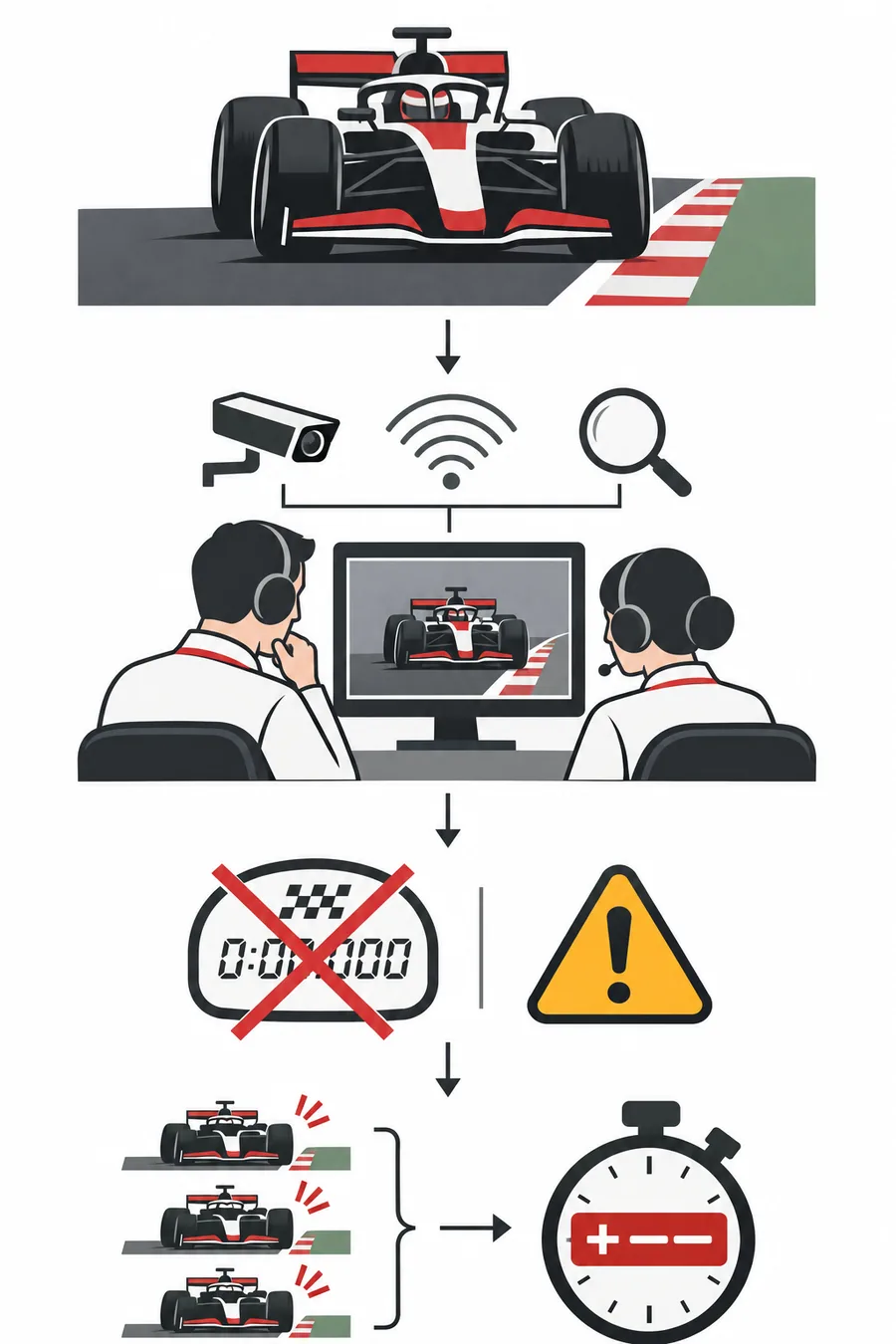
A track-limit call starts with the physical definition of the corner. Officials may review timing loops, fixed cameras, onboard footage, kerb sensors or a remote-control-centre alert. The question is not simply whether the car looked wide in a broadcast shot. Officials need to decide whether the car was outside the defined boundary, whether the evidence is clear and whether the incident belongs to the monitored part of the circuit.
The four-wheel idea is useful for viewers: if a sliver of the car remains in contact with the legal track, the car may still be inside the limit. But the driver cannot treat that as permission to drive over every kerb. The car must also rejoin safely, avoid forcing another driver off and avoid gaining a lasting advantage. If a driver cuts a corner and immediately gives back the time or position, the stewards can take that context into account.
This is why a broadcast graphic may first show a lap under investigation and only later show a deleted lap or a penalty. Race control can collect evidence, send it to the stewards and then publish a decision. The delay does not automatically mean the system failed; it often reflects the need to separate a clear lap deletion from a more complex sporting judgment.
| Question | Typical evidence | Viewer takeaway |
|---|---|---|
| Did all four wheels leave the track? | Track definition, camera or sensor view | A white line is a boundary, not a decoration |
| Was the corner monitored? | Event notes and race-control instructions | Not every metre of runoff is treated identically |
| Was an advantage gained? | Timing, position and steward review | Giving back a gain can change the outcome |
| Was the rejoin safe? | Video and driver-to-driver context | Avoiding a collision remains part of the rule |
What Happens in Practice and Qualifying?
Practice sessions usually use track limits as a lap-validity and feedback tool. A driver may see a lap deleted from the timing screen, receive a team message or be told that a corner is being watched. The deletion can still matter because teams use practice runs to choose a setup and understand the true pace of a tyre. A fast-looking lap that is not legal should not drive the team's comparison.
In qualifying, the consequence is sharper because one deleted lap can remove a driver from the next segment or change the starting grid. If the infringement happens on the final corner before the pit straight, the next lap can also be affected because the invalid line carried into the following timed lap. Drivers therefore leave a margin at known hotspots when they need a safe banker lap, then decide whether the possible time gain is worth the risk on a final attempt.
Track limits also explain why a qualifying result can change after the chequered flag. The timing screen may show a provisional lap while officials check an incident. A later deletion is not a new performance penalty; it is a correction that removes a lap which did not meet the published track definition.
| Session | Common consequence | How to read it |
|---|---|---|
| Practice | Lap deletion or warning | Use legal laps for setup and tyre comparisons |
| Qualifying | Lap deletion, sometimes affecting the next timed lap | A deleted best lap can change progression and grid position |
| Sprint qualifying | Same basic validity concern under the event format | Check the weekend notes because the schedule is compressed |
How Many Track Limits Before a Race Penalty?
The familiar Grand Prix pattern is a sequence of warnings rather than an automatic penalty for the first single excursion. Teams are told where a driver has exceeded the limit, and a black-and-white flag can act as a final warning. A further infringement can be referred for a five-second penalty, with a larger penalty possible if the driver continues. The exact count and sanction depend on the current regulations, the event notes and whether the incidents are considered comparable.
For a fan, the important distinction is between a deleted lap and a race-time penalty. A deleted lap removes a performance from the classification of a session. A time penalty changes the race result by adding seconds at a pit stop or after the chequered flag. A driver can therefore lose a qualifying lap without receiving a race penalty, or receive a race penalty after repeated violations even if no single lap looks dramatic.
Do not reduce the rule to a universal slogan such as "three strikes everywhere." The stewards can review a driver leaving the track to avoid contact, being pushed wide, or gaining no lasting advantage. Read the race-control message and the final steward decision together, especially at circuits where many cars approach the same painted line.
| Race-control signal | Meaning | Possible result |
|---|---|---|
| Team notification | A monitored infringement has been recorded | Driver receives a warning and must correct the line |
| Black-and-white flag | Final sporting warning for repeated behaviour | Another breach can be referred to the stewards |
| Five-second penalty | A race-time sanction has been imposed | Serve it at a stop or add it to the final time |
| Ten-second or larger sanction | Continued or aggravated breaches | The final classification can change after the race |
Why Do Some Circuits Create More Track-Limit Debates?
The debate becomes louder when a corner has a wide, flat asphalt runoff. A driver can gain time by using extra space without immediately damaging the car, so every team searches for the last legal millimetre. The Red Bull Ring became a well-known example after large numbers of potential incidents required review. Similar pressure can appear at any circuit with fast exits, painted kerbs and little natural deterrent beyond the white line.
Gravel strips and raised kerbs change that incentive. A car that touches gravel loses speed and may damage its floor, so the physical consequence can police the boundary before officials need to issue a decision. Sausage kerbs can also discourage a wide line, although circuit designers must balance the deterrent with the risk of launching or damaging a car. There is no single track-limit fix that works at every corner.
Monitoring technology is improving, but technology does not replace the sporting rule. Cameras and software can identify likely incidents faster; race control still needs a defined boundary and the stewards still interpret context. When a broadcast says that an AI system flagged a car, it does not mean a machine invented a new penalty.
How Should Fans Read a Track-Limit Call?
Start with the session and the location. A deleted qualifying lap, a black-and-white flag in the race and a post-race time penalty are related but not interchangeable. Then check whether the message refers to a specific monitored turn, a lap time, a lasting advantage or a repeated count. This vocabulary tells you what race control is actually deciding.
Next, compare legal pace rather than the headline number. If a driver set the fastest time with all four wheels outside the line, the impressive lap is not evidence that the driver was genuinely faster under the rules. The same principle applies to a strategy chart: a tyre or pit-window comparison is useful only when the laps being compared are valid. The site's F1 tyre compounds guide adds context about grip and degradation, while the blue flag guide covers a different race-control signal.
Finally, remember that an online reaction test is unrelated to track-limit enforcement. You can use the F1 Start Timer to practise waiting for lights out, but it does not judge whether a car stayed between white lines. Keeping those tasks separate makes both the sporting explanation and the practice result clearer.
- 1. Identify the session: Practice, qualifying, sprint qualifying and the Grand Prix have different consequences.
- 2. Find the monitored corner: Event notes usually name the turns where the boundary is actively checked.
- 3. Separate lap and race effects: A deleted lap is not the same thing as seconds added to a race result.
- 4. Read the final decision: A review message is provisional; the steward document explains the confirmed outcome.
F1 Track Limits FAQ
Sources and Scope
This guide is a fan-facing explanation based on the current FIA Formula 1 regulations, the FIA driving-standards guidance and the rule summaries checked during research. Sporting regulations and event notes can change, so a live Grand Prix decision should be read from the official stewards' document.
The article uses public reporting from Motorsport.com, Motor Sport Magazine and The Athletic to compare how track-limit definitions, deleted laps, warnings and time penalties are explained. Those sources are used for context rather than treated as a substitute for the official regulations.
F1 Start Timer is an independent fan-made site and is not affiliated with Formula 1, the FIA or any racing team. The images are editorial illustrations, not official circuit-camera footage or steward evidence.
Last updated: November 15, 2026