F1 Red Flag Explained: Meaning, Rules, Restarts and Safety Car Differences
A practical guide to why race control stops a session, what drivers do next, and how a red-flag restart differs from a Safety Car period.

What Does a Red Flag Mean in F1?
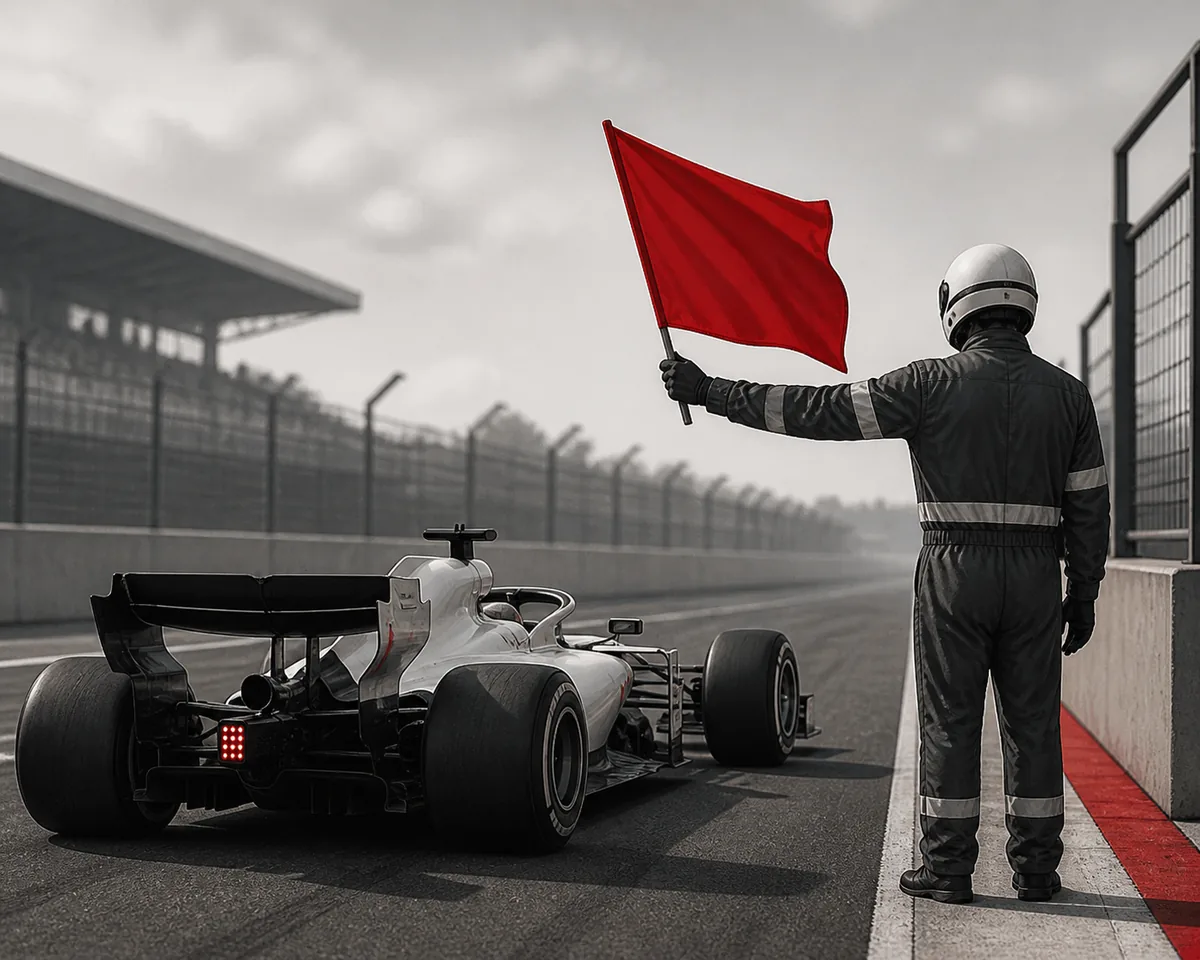
The red flag in F1 means that the current session is suspended. It is used when drivers, marshals or other track workers cannot be protected by ordinary local flags, a Virtual Safety Car or a physical Safety Car alone. The signal is about the condition of the circuit and the safety of the people on it, not about which driver is winning.
When the flag is active, drivers must reduce speed and follow the instructions displayed by race control. The normal competitive flow stops: there is no ordinary racing, no chasing the car ahead and no assumption that the next lap will continue under green conditions. The cars are usually brought back to the pit lane or another controlled location while officials assess the incident.
A red flag therefore differs from a normal caution. A yellow flag asks drivers to slow for a local hazard. A Safety Car neutralizes the field while the session continues. A red flag is the stronger interruption: officials pause the sporting activity so the circuit can be made safe or the event can be reorganized.
| Signal | What it changes | What fans should understand |
|---|---|---|
| Red flag | The session is suspended | Racing or timed running stops until officials decide what happens next |
| Safety Car | The field is neutralized | Cars remain in the session and follow a controlled pace behind the lead car |
| VSC | A delta controls speed | Cars slow to required time targets without a physical Safety Car leading them |
When Is an F1 Red Flag Shown?
Race control can show a red flag when the circuit needs more protection than a normal caution procedure can provide. A serious crash, extensive debris, damaged barriers, standing water, poor visibility, a blocked racing line or a situation that requires workers and recovery vehicles on the track may all justify a suspension. The decision is made for the whole session because the risk affects more than one corner or one driver.
The flag is not an automatic verdict on the cause of an incident. It does not by itself say that a driver is at fault, that a car is written off or that the race will be restarted. It simply creates a controlled pause. Stewards can review the incident separately, while race control focuses on the immediate safety problem and the condition of the event.
The most useful rule for viewers is to watch the official messages rather than infer a fixed pause length. A red flag may last only long enough to clear debris, or it may continue while barriers, drainage, recovery equipment or weather conditions are dealt with. The public timetable can change because the safety assessment comes first.
- Track access: marshals or recovery crews need to work on a section that cannot safely remain live.
- Major obstruction: a car, debris, damaged barrier or fluid makes normal running unsafe across a meaningful part of the circuit.
- Weather or visibility: rain, standing water, spray, fog or a sudden loss of visibility prevents drivers from operating safely.
- Event control: officials need to reorganize the session or prepare the conditions for a controlled continuation.
Red Flags in Practice, Qualifying and a Grand Prix
The meaning of the red flag is consistent across the weekend—running is suspended—but the sporting consequences depend on the session. In practice, teams lose track time and may have to change their test plan. In qualifying, the clock and the number of remaining attempts become central, so a suspension can change who gets a clean final lap and how traffic is managed.
During a Grand Prix, the red flag can change the race from a continuous contest into separate phases. The order, lap count, tyre choices and damage situation must be interpreted using the regulations and the official restart information. A driver who was leading before the suspension is not automatically guaranteed the same strategic advantage after the pause.
This is why a headline such as ‘red flag restart’ needs context. A red flag in Q1 is not the same problem as a red flag late in the race. The signal is the same, but the remaining time, available tyres, repair opportunities and restart format can be very different. For the separate lights-out procedure, see the guide to F1 starting lights.
| Session | Immediate effect | Main strategic question |
|---|---|---|
| Practice | Timed running pauses | Which tests or tyre runs can still be completed? |
| Qualifying | The clock and lap attempts are interrupted | Who has a safe final run and which drivers are exposed to traffic or timing? |
| Race | Competitive running is suspended | How will the official restart, tyre state and remaining distance reshape the contest? |
What Happens During a Red-Flag Restart?
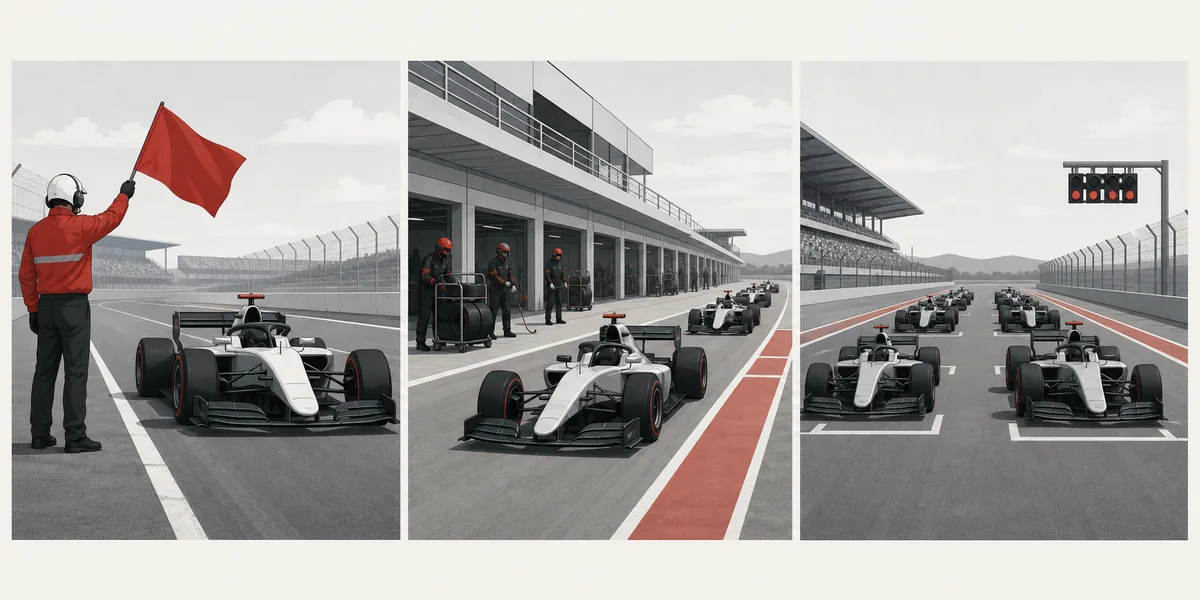
A restart is not simply the red lights turning off again. First, race control confirms that the circuit and working areas are ready. Teams receive instructions about where the cars should go, when they may leave the pit lane and which procedure applies. Drivers must follow the official messages and flags rather than treating the pause as an informal reset.
The cars may need inspection, repairs, tyre decisions or a change of setup while the session is suspended. Those options are governed by the applicable sporting rules and the point reached in the session. A damaged front wing, a puncture, overheating brakes or a need to change tyres can matter differently before a qualifying run than during a race restart.
Once the field is ready, the event follows the announced restart procedure. Depending on the session and the regulations in force, this can involve cars returning to the grid or being released in a controlled order before racing resumes. The important point is that the restart is an official race-control sequence with its own instructions, not a continuation that drivers improvise.
- 1. Safety check: officials confirm that the hazard, surface, barriers and worker-access problem are under control.
- 2. Team preparation: crews check damage, tyres, fuel or energy state and the setup choices allowed by the rules.
- 3. Procedure notice: race control communicates the timing, location and restart method for the session.
- 4. Controlled resumption: drivers follow the formation, pit-lane and lights or flag instructions before competitive running returns.
F1 Red Flag vs Safety Car and VSC
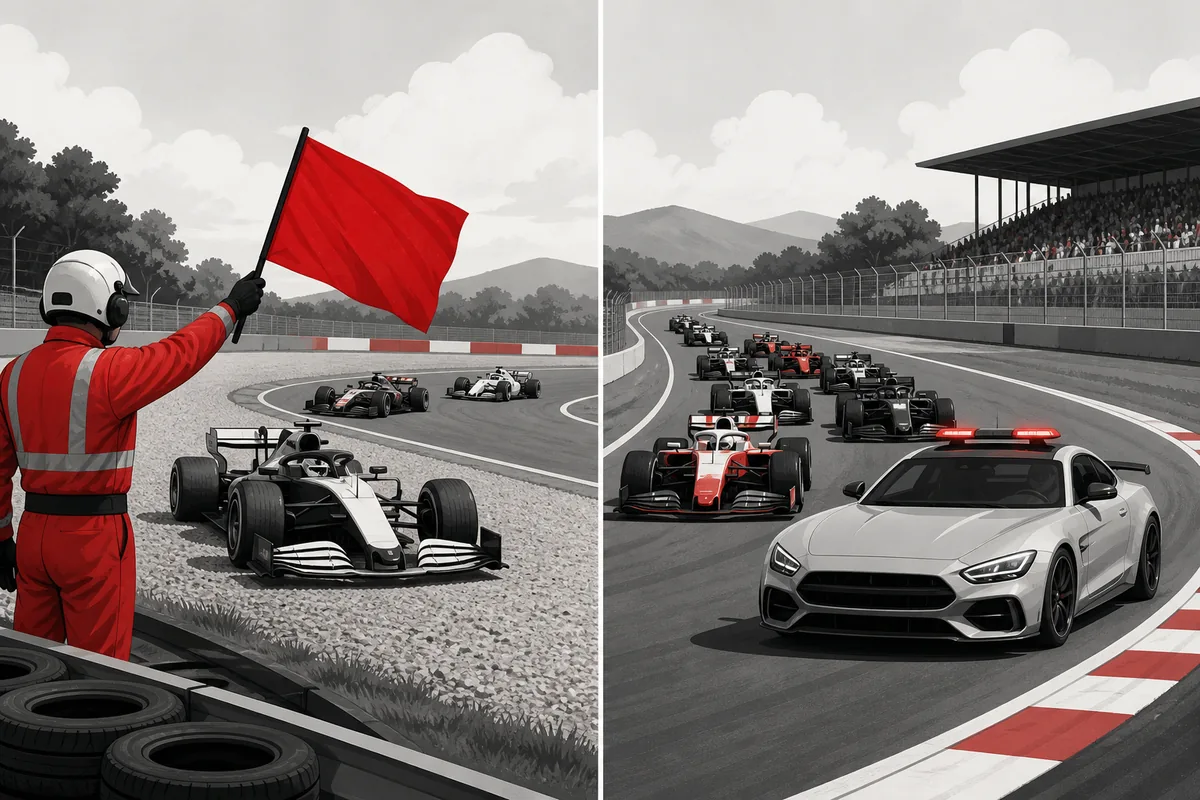
The easiest way to separate the procedures is to ask whether the sporting session is still running. Under a Safety Car, the race continues: drivers queue behind the physical car, laps normally continue and the field is controlled at a reduced pace. Under a VSC, drivers remain on track and obey a delta without a physical lead car. Under a red flag, the competitive session is suspended while officials manage the safety problem.
The procedures can appear in the same incident. A local yellow flag may be followed by a VSC, then a Safety Car, and finally a red flag if the hazard proves more serious or the circuit needs workers on it. They are not interchangeable labels for ‘something happened’; each one tells the driver a different level of control is active.
The site’s F1 Safety Car guide covers physical Safety Car deployment, VSC and controlled restarts in more detail. The short version is that the Safety Car compresses the field without stopping the session, while the red flag pauses the session itself.
| Question | Red flag | Safety Car / VSC |
|---|---|---|
| Are cars still racing? | No; the session is suspended | The session continues under a neutralized pace |
| Where are the cars? | Normally in the pit lane or another controlled location | On the circuit, following the procedure |
| Does the field bunch up? | It may be reorganized for the official resumption | A physical Safety Car normally compresses the order; VSC gaps are more preserved |
| What decides the next step? | Safety assessment and official restart instructions | The end-of-neutralization message and the applicable Safety Car or VSC procedure |
What a Red Flag Changes for Cars, Tyres and Strategy
A red flag creates a pause, but it does not erase every strategic consequence from before the incident. Drivers can lose track position, teams can gain time to repair damage, and tyre temperatures can fall while the cars are stationary. Whether a team benefits depends on the rules, the timing and the condition of its car—not simply on whether it was leading or behind.
Tyres are especially easy to misunderstand. A driver may return to the track on a different compound after the suspension only when the relevant rules and the team’s available tyres allow it. The pause can reduce the normal cost of a pit stop or change the value of a planned one, but it does not make every tyre choice free or remove the requirement to follow the event’s tyre regulations.
Repairs and setup work also have boundaries. Mechanics may be able to replace damaged parts or prepare the car, but teams cannot assume they can rebuild the entire vehicle or change every parameter. The safest explanation for a viewer is to treat the red flag as a reset of track activity, not a guarantee that all previous consequences disappear. For a related race-procedure example, compare it with the F1 formation lap and the blue flag rules.
| Area | Possible effect | Why it is not automatic |
|---|---|---|
| Track position | The order may be reorganized for a restart | The official classification and restart procedure control the result |
| Tyres | A pause can change compound and pit-stop decisions | Tyre availability and sporting rules still apply |
| Damage | Teams may gain time to inspect or repair the car | The work allowed depends on the session and regulations |
| Temperatures | Tyres, brakes and power-unit systems can cool | Teams must manage the restart and may not regain normal operating windows immediately |
F1 Red Flag FAQ
Official Sources and Scope
Rule wording and the current sporting context were checked on August 22, 2026 against the FIA 2026 Formula 1 Sporting Regulations, Issue 7. The article uses cautious wording where the exact restart procedure depends on the session and the official instruction.
Fan-facing flag definitions were cross-checked against Formula 1’s beginner’s guide to F1 flags. F1 Start Timer is an independent explainer site and is not affiliated with Formula 1 or the FIA.
Last updated: August 22, 2026