Virtual Safety Car F1: What VSC Means and How It Works
A clear guide to VSC signals, delta control, overtaking, pit stops, and the difference between a Virtual Safety Car and a physical Safety Car.

What Is the Virtual Safety Car in F1?
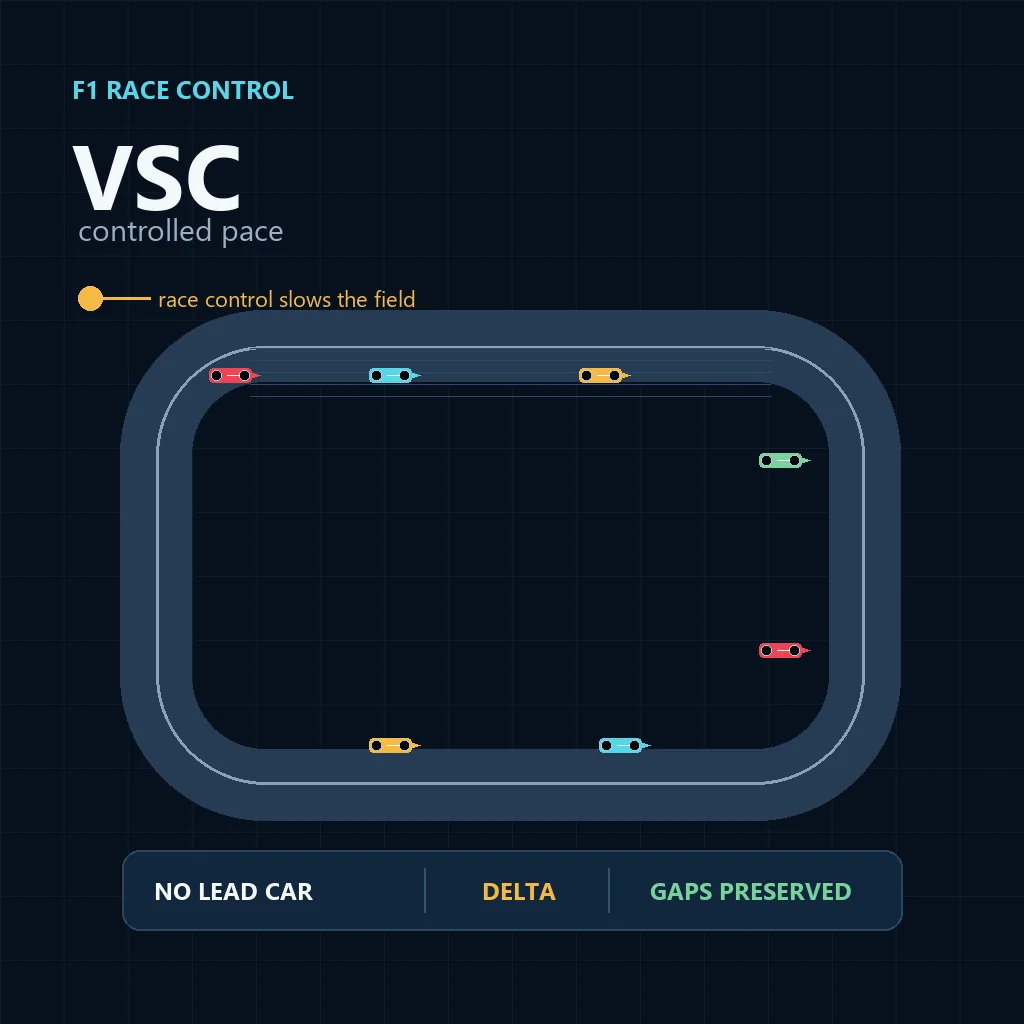
The Virtual Safety Car (VSC) is a race-control procedure that slows every F1 car without sending a physical safety car onto the circuit. When an incident makes normal racing unsafe but a full Safety Car is not necessary, race control sets a controlled pace and displays the relevant VSC signals.
Instead of following one lead vehicle, each driver must stay within a required delta—a target time for a sector or part of the lap. The field therefore stays more spread out than it would behind a physical Safety Car, while marshals can work with a lower-speed, more predictable flow of traffic.
The short definition
A VSC is a digital pace-control procedure: the whole field slows to a regulated delta, but there is no physical car gathering everyone into a queue.
When Does F1 Use a VSC?
Race control uses a VSC when the hazard is serious enough to require a whole-track reduction but does not need the cars to queue behind a physical vehicle. A stranded car, debris, recovery work, or a short-lived danger can all lead to a VSC, depending on location, visibility, and the time needed to make the circuit safe.
A VSC is not triggered by a fixed checklist that viewers can apply from home. Officials choose the least disruptive procedure that still protects drivers and workers. Local yellow flags may be enough for a small hazard; a physical Safety Car may be safer when the field must be gathered or the incident is more complex.
- Track hazard: a stopped car, debris, or recovery work creates risk at one part of the circuit.
- Worker protection: marshals need a predictable low-speed window to reach and clear the incident.
- Visibility or weather: spray, rain, dust, or a blocked sight line can make racing speed unsafe.
- Race-control judgment: officials select the neutralization that matches the danger and its expected duration.
How the VSC Delta Works
The word delta means the time reference a driver must respect. On the broadcast, a driver may be shown as positive or negative relative to the target. The goal is not to set the fastest possible lap; it is to stay within the allowed VSC pace while avoiding a violation.
Drivers lift off, brake earlier, and manage speed through the control sectors. They still need to drive safely, keep the car under control, and follow flags, boards, radio instructions, and pit-lane rules. The exact target is not one universal speed number: it is calculated through the event's timing system and regulations.
That is why a VSC can look uneven on television. One driver may be approaching a timing line, another may be leaving a slow corner, and a third may be preparing for pit entry. All are responding to the same neutralization, but the visual speed and gap can change across the lap.
- Race control activates: VSC boards, lights, timing information, and official messages tell the field that the controlled period has begun.
- Drivers reduce pace: each car slows to the required delta instead of racing at full speed or following a lead vehicle.
- The hazard is handled: marshals and recovery crews work while the lower-speed flow gives them protection.
- Racing resumes: the VSC end message is communicated, and drivers return to normal racing only when officially permitted.
Virtual Safety Car vs Safety Car
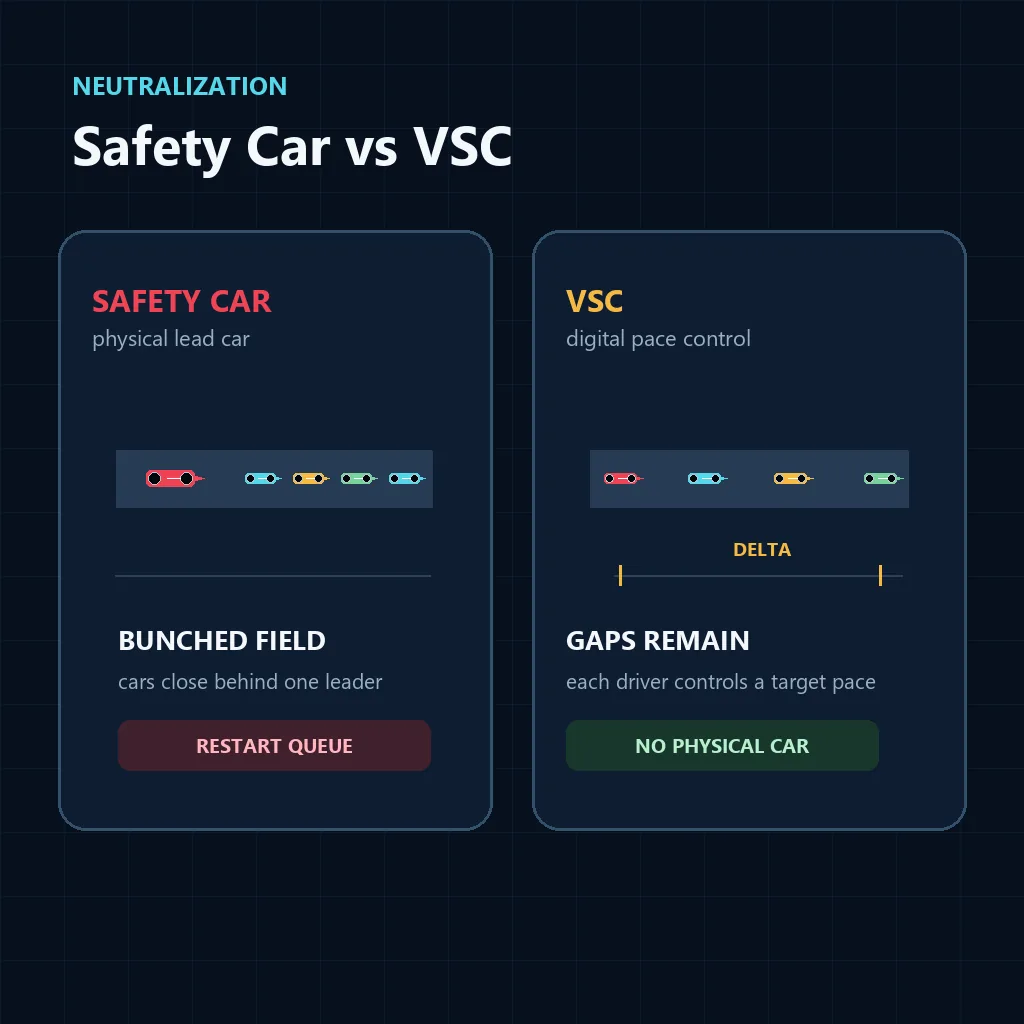
The most important difference between a VSC and a physical Safety Car is what happens to the gaps. A VSC slows each car separately, so a driver who had a ten-second advantage will usually keep much of that advantage. A physical Safety Car leads the field and compresses those gaps into a controlled queue.
Both procedures prohibit normal racing and overtaking in ordinary circumstances. The difference is sporting impact: a VSC often creates a short strategic pause, while a physical Safety Car can reset the order before a close restart.
| Feature | Virtual Safety Car | Physical Safety Car |
|---|---|---|
| Lead vehicle | No physical lead car | A safety car leads the field |
| Pace control | Drivers follow a delta | Drivers follow the car and official signals |
| Field shape | Gaps are more likely to remain | Cars usually bunch into a queue |
| Overtaking | Normally prohibited | Normally prohibited |
| Restart effect | Cars resume from their existing spread | A close restart is more likely |
Overtaking, Pit Stops, and Strategy Under VSC
Can you overtake under a VSC? Usually no. Drivers must respect the neutralization, the delta, flags, and race-control messages. A car should not use the reduced pace as an opportunity to pass a rival; any exception has to come from the applicable regulations or an explicit official instruction.
Pit stops are allowed through the normal pit-entry and pit-exit procedure, but their value depends on timing. Because the field is slowed, the relative time cost can be smaller than under green flags. The team still has to consider traffic, tyre temperature, track position, pit-lane limits, and whether the VSC ends before the car rejoins. See the site's F1 delta time guide for the timing concept behind these comparisons.
- Pit now: the lower-speed period may reduce the time lost relative to rivals who stay out.
- Stay out: track position can be worth more than a fresh set of tyres when the gaps are preserved.
- Manage the tyres: a slow period can cool the tyres, making the first corners after green conditions harder.
- Protect the rejoin: a clean exit and space in traffic can matter more than the theoretical pit-stop saving.
How to Read a VSC Period as a Viewer
When a VSC appears on the broadcast, first look for the on-screen VSC banner and the timing or delta information. Do not judge a driver's performance only by the apparent gap: a car may be complying with the target while another is at a different point in the timing sequence.
Next, watch the order of the pit stops and the message that ends the VSC. A driver who pits may gain relative time but lose track position; a driver who stays out may keep the place but restart on older tyres. Reading those two choices together explains why a short neutralization can change the race.
- Signal: confirm that the broadcast is showing VSC rather than a local yellow or a physical Safety Car.
- Delta: use the timing display as the pace reference, not the raw lap-time comparison.
- Pit window: check which drivers stop and whether they rejoin in clean air or traffic.
- End message: wait for the official return to racing before treating an overtake or attack as legal.
Virtual Safety Car F1 FAQ
Official Sources and Scope
This article uses plain-language descriptions of Formula 1 neutralization procedures. For exact wording, exceptions, and event-specific instructions, consult the current FIA Formula 1 regulations and the sporting documents issued for the event.
The official Formula 1 glossary is useful for general terminology. F1 Start Timer is an independent explainer site and is not affiliated with Formula 1 or the FIA.
Last updated: September 12, 2026